Research
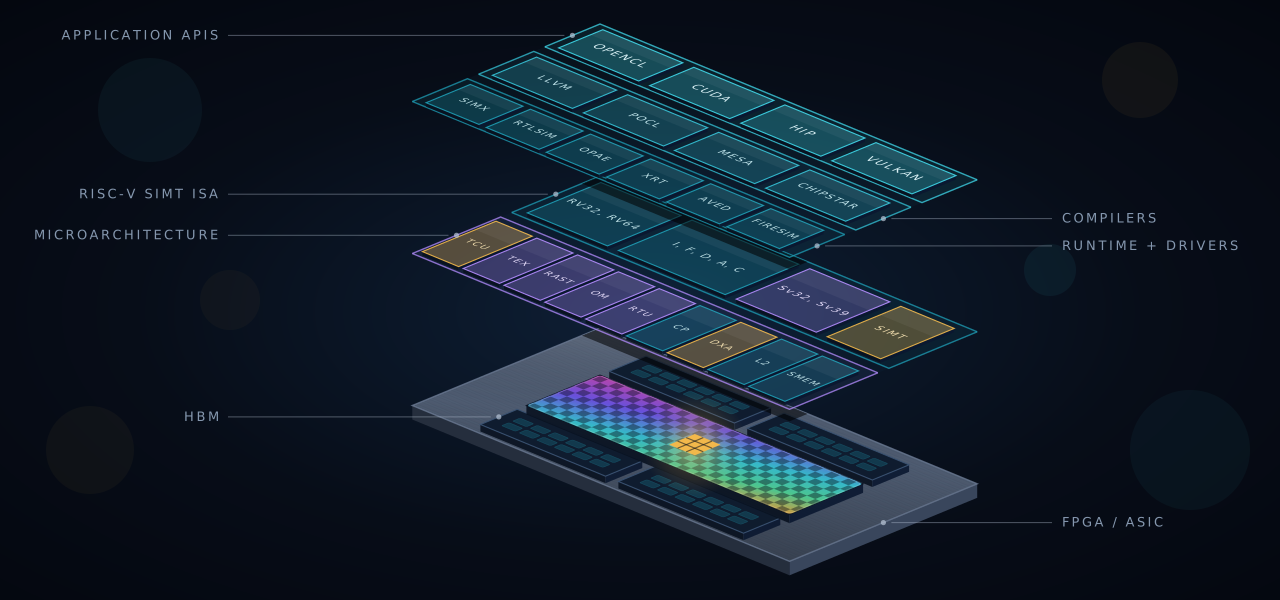
My research program is built around Vortex, a full-stack, open-source RISC-V GPU. A credible open GPU platform is a prerequisite for reproducible architecture research, and for hands-on education that is not locked inside proprietary hardware. Vortex has since grown into each major domain of modern GPU architecture.
Memory and graphics
We extended Vortex with high-bandwidth memory support to increase memory-level parallelism, and integrated a complete graphics hardware stack.
- Skybox: Open-Source Graphic Rendering on Programmable RISC-V GPUs (ASPLOS 2023)
- Towards “True” GPU Performance Scaling for OpenGPU (Hot Chips 2024)
- Analysis of the RISC-V Vector Extension for Vulkan Graphics Kernels (ISPASS 2025)
Vector ISA and compilers
We added RISC-V vector ISA support to the GPU and extended the compiler stack to target it, along with CUDA compatibility and fast performance modeling.
- VESICA: Fused Vector Extension for RISC-V Embedded GPUs (ICCAD 2026)
- Inside VOLT: Designing an Open-Source GPU Compiler (CC 2026)
- SoftCUDA: Running CUDA on Softcore GPU (FCCM 2025)
- FastTrackGPU: Static-Analysis-Guided Analytical Modeling for Softcore GPUs (IEEE CAL 2026)
Tensor AI and ray tracing
We broadened Vortex to support tensor-core architectures, structured and unstructured sparsity, and dedicated ray-tracing hardware.
- PRISM: Accelerating Ray Tracing on RISC-V GPU (ICCD 2026)
- Sparse tensor cores, 2:4 structured sparsity, microscaling formats, asynchronous barriers and TMA (OSCAR 2026)