Building My Own Car
A childhood story about turning scraps into a car
Published:
Part 1: The Car Club
When I was about nine years old, growing up in Cameroon, I was very lucky to have LEGO toys. They were among the best toys I ever had. With a collection of colorful bricks and a little imagination, I could build almost anything I wanted. I built houses, animals, trains, boats, and all sorts of things. But my favorites were always cars.
Perhaps that was because my dad had a car, and I was fascinated by cars. Unlike a house or an animal made from LEGO, a car could actually move! I could push it across the floor, load it with small objects, and imagine it carrying people and goods from one place to another. I could build a small car one day and a big truck the next. And whenever I got tired of something I had built, I could take it apart and start all over again.
That was the magic of LEGO. The same little bricks could become almost anything.
But as much as I loved LEGO, there were two things that bothered me.
First, everything I built had to be made from the same familiar bricks. I could be as creative as I wanted, but I was still limited by the shapes of the pieces and the ways they could fit together. Sometimes, what I imagined in my head was simply not possible to build with the pieces I had.
The second problem was even more frustrating. I had nobody to play with. Building LEGO cars was fun, but it was mostly something I did alone. I had nobody to race against, nobody to compete with, and nobody to share my latest creations with. I could spend hours building a wonderful little car, only to end up driving it around the house by myself.
Then one afternoon, something happened that changed the way I thought about making toys.
The mysterious cars
I was walking home from school when I noticed a small group of boys passing through our neighborhood. There were four or five of them, chatting and laughing as they walked along the road. Every now and then, they would break into a run, as though they were racing one another.
At first, I couldn’t understand what they were doing.
Each boy was holding a long wooden stick, pointing it toward the ground in front of him. My eyes followed the sticks, and that was when I noticed something extraordinary.
At the other end of each stick was a miniature car!

The boys and their handmade cars on the neighborhood road.
But these were no ordinary toy cars. They were certainly not made from LEGO. Their bodies appeared to be made from pieces of wire, carefully bent into shapes that resembled real cars. They had wheels, axles, and all sorts of other parts that I couldn’t recognize. Somehow, the boys could use their long sticks to guide the cars left and right, even while running.
I was astonished.
Their cars looked far more realistic than the little LEGO cars I had been building. And then I realized something remarkable: these boys had made their cars themselves, from scratch. No box of bricks. No ready-made wheels. No instructions. Somehow, they had figured out how to make all the parts they needed.
How did the wheels turn? What held the cars together? How did a wooden stick make a car change direction? And why did the cars seem to bounce so easily over the uneven road?
I had so many questions.
But there was something else I couldn’t stop watching: they were having so much fun together. They laughed, raced, and showed off their creations. They seemed incredibly proud of what they had made.
I wanted to understand how their cars worked. I wanted to build one myself. And I wanted to join them.
There was just one problem. I was a shy kid, and I didn’t know any of those boys.
The boy who handed me his car
That first afternoon, I kept my distance. I followed a little way behind, pretending to mind my own business while trying to catch every glimpse of their cars.
Eventually, the boys noticed me. They turned and looked in my direction. I felt embarrassed. But they said nothing, and they didn’t tell me to leave. After a moment, they carried on, and I continued watching from afar.
The following afternoon, I saw them again.
This time, I gathered enough courage to approach a little closer.
“Hi,” I said.
They greeted me back.
I wanted to ask a hundred questions, but the words wouldn’t come. So I stood nearby, quietly studying the cars.
Then the youngest boy in the group walked toward me and held out the wooden stick attached to his car.
He was letting me try it!
I took the stick and started walking. The car rolled in front of me. I moved the stick to the left, and the car turned left. I moved it to the right, and it turned right. It was wonderful! I could guide this little machine along the road, just like the boys did.
Then the car rolled over a few small stones. Its back wheels bounced gently, but the car stayed together. I had never seen anything quite like it. How could a car made from scraps do that?
The boy lifted his car so I could get a better look. He showed me its wire body, its wheels cut from old rubber flip-flops, and the hollow pen tubes that helped the wheel axles turn. At the back, he showed me strips of rubber that allowed the rear wheels to move over bumps. And he showed me how the long stick controlled the front wheels.
Best of all, he explained where they found their materials. The wire came from leftovers at house construction sites. The springy rubber came from old tire inner tubes discarded at a mechanic’s garage. Other parts came from worn-out sandals, empty pens, and palm-leaf brooms.
I knew those places! There were construction sites and a mechanic’s garage not far from the road I took to school. I had passed them many times without paying attention to the things people left behind.
Now I saw those scraps differently. An old flip-flop could become a set of wheels. An empty pen could help an axle spin. A piece of rubber could become a spring.
I went home that day with the boy’s car still on my mind. He hadn’t simply let me play with it. He had shown me how ordinary things could become parts of a machine.
I knew where I might find the materials. Now came the difficult part: could I turn them into a car of my own?
Part 2: A Car Made of Leftovers
Looking for parts
Over the following days, I started collecting what I would need. Old flip-flops from home could provide the wheels. Empty BIC pens would be useful for the axles. From a palm-leaf broom, I could pull out a few stiff, straight stalks. I needed lengths of wire for the body, a wooden stick for steering, and—most important of all—strips cut from an old tire’s inner tube.
The construction sites and mechanic’s garage that I had passed on my way to school suddenly became places full of possibilities. What used to look like rubbish now looked like a collection of spare parts.
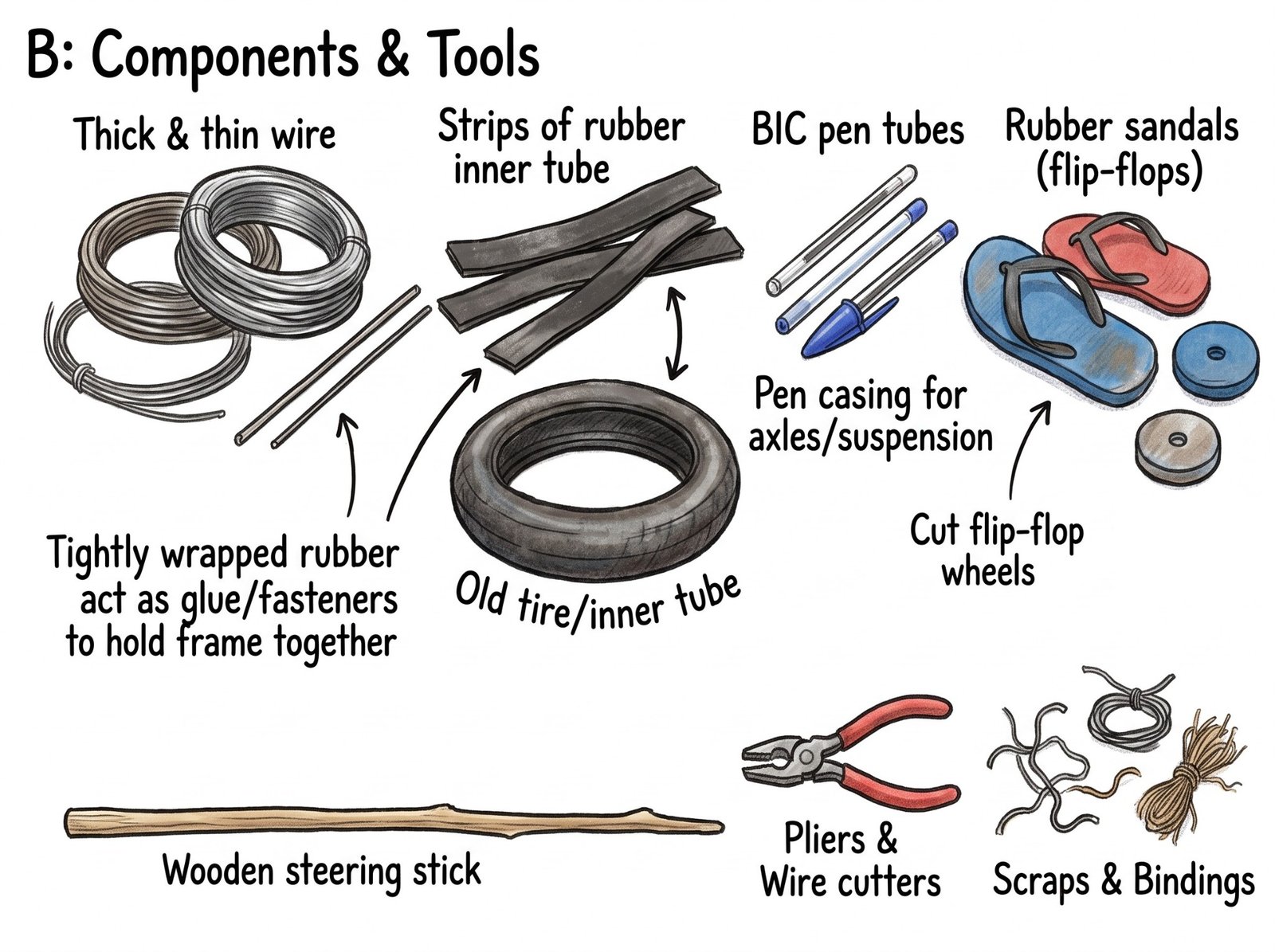
Almost everything I needed came from ordinary things that had been used, broken, or thrown away.
I was excited, but I was also about to discover something important. Understanding someone else’s car is not the same as knowing how to build your own.
Making wheels that could really turn
I began with the wheels. I cut four round pieces from the thick soles of old flip-flops. They didn’t have to be beautiful, but they needed to be round enough to roll.
For each pair of wheels, I used a stiff stalk from a palm-leaf broom. This was my axle: the rod connecting the two wheels. But I couldn’t simply tie the axle tightly to the car. If it was tied down, how would the wheels turn?
I remembered the boy’s trick with the empty pens.
I slid each axle through a hollow BIC pen tube and attached a wheel to each end of the axle. The axle could spin inside the pen tube, while the pen tube itself could be held in place. A small piece of plastic that once held ink was now part of a rolling machine.
I later learned that engineers have a word for a part that supports something while allowing it to turn: a bearing. Real cars use carefully made bearings, often with tiny steel balls or rollers to reduce friction. Mine used the smooth inside of an old pen. It was simple, but it worked.
I could make the wheels spin. That felt like a victory.
But four spinning wheels were not yet a car.
The hardest part: building the skeleton
The next challenge was the chassis, the frame that holds a car together. It is like a skeleton: everything else depends on it.
I had a picture in my mind of the car I wanted—a long body, a front end, a place for the wheels, and a shape that looked something like the real cars I admired. But I didn’t have a drawing. I didn’t even know that making a drawing first might help.
So I started bending wire.
I would make one side, then try to make the other side match it. I would connect two pieces and discover that the frame was crooked. I would finally get the shape looking right, only to realize that a wheel or axle no longer fit where it needed to go.
Then I would undo it and start again.
Stuck. Restart. Stuck. Restart.
It was frustrating. With LEGO, the bricks were designed to fit neatly together. Here, I had to decide where every wire should bend and how every connection should hold. To fasten the wire pieces, I wrapped thin strips of rubber tightly around their joints. They worked like little ties, holding the frame together without needing glue.
Some days I made progress. Other days I seemed to undo everything I had done before. What I wanted to make in my imagination was much easier than what I could make with my hands.
But I kept trying. Each failed attempt taught me something. Which joints needed to be stronger? Which pieces were too long? Where should the wheels go? And which parts must not be attached tightly, because they needed to move?
Little by little, a real chassis began to take shape.
The steering trick
One of those moving parts was the front axle.
I wanted to steer my car with a long wooden stick, just like the boys did. The stick connected to the middle of the front axle assembly. Near the front of the chassis, a pivot supported the steering assembly while allowing it to turn from side to side.
When I moved the stick left, the entire front axle turned left. When I moved it right, the axle turned right. The two front wheels steered together, rather like the wheels on a small wagon.
The important thing was that the front axle could turn relative to the chassis. If I had tied it rigidly to the sides of the wire frame, it would have pointed straight ahead forever. The front wheels also needed to keep rolling freely around their axle; turning the steering stick and spinning the wheels were two different movements.
When it finally worked, I could guide the car instead of just pushing it straight ahead.
My favorite invention: rubber springs
The rear wheels presented a different problem. Our roads had little stones, bumps, and uneven patches. I wanted the back wheels to move up and down over those obstacles without shaking the entire wire frame apart.
The answer was the rubber from an old tire’s inner tube.
I cut two flat strips from the rubber and fixed them horizontally across the rear section of the chassis. Then I attached the rear BIC pen tube, which held the rear axle, beneath those two strips. Unlike the front steering assembly, the rear axle was not connected rigidly to the wire frame. It hung from the flexible rubber.
That small difference changed everything.
When the back of the car pressed down or the wheels met a bump, the rubber could stretch and flex. The rear axle moved up and down relative to the chassis, then the rubber helped pull it back. The car could bounce instead of taking every bump as a hard knock.
I had made a suspension system!
Of course, I didn’t know the word suspension at the time. I only knew that the idea was clever—and that it made my car much more fun to drive. The front wheels had no such spring system; they belonged to the steering assembly.
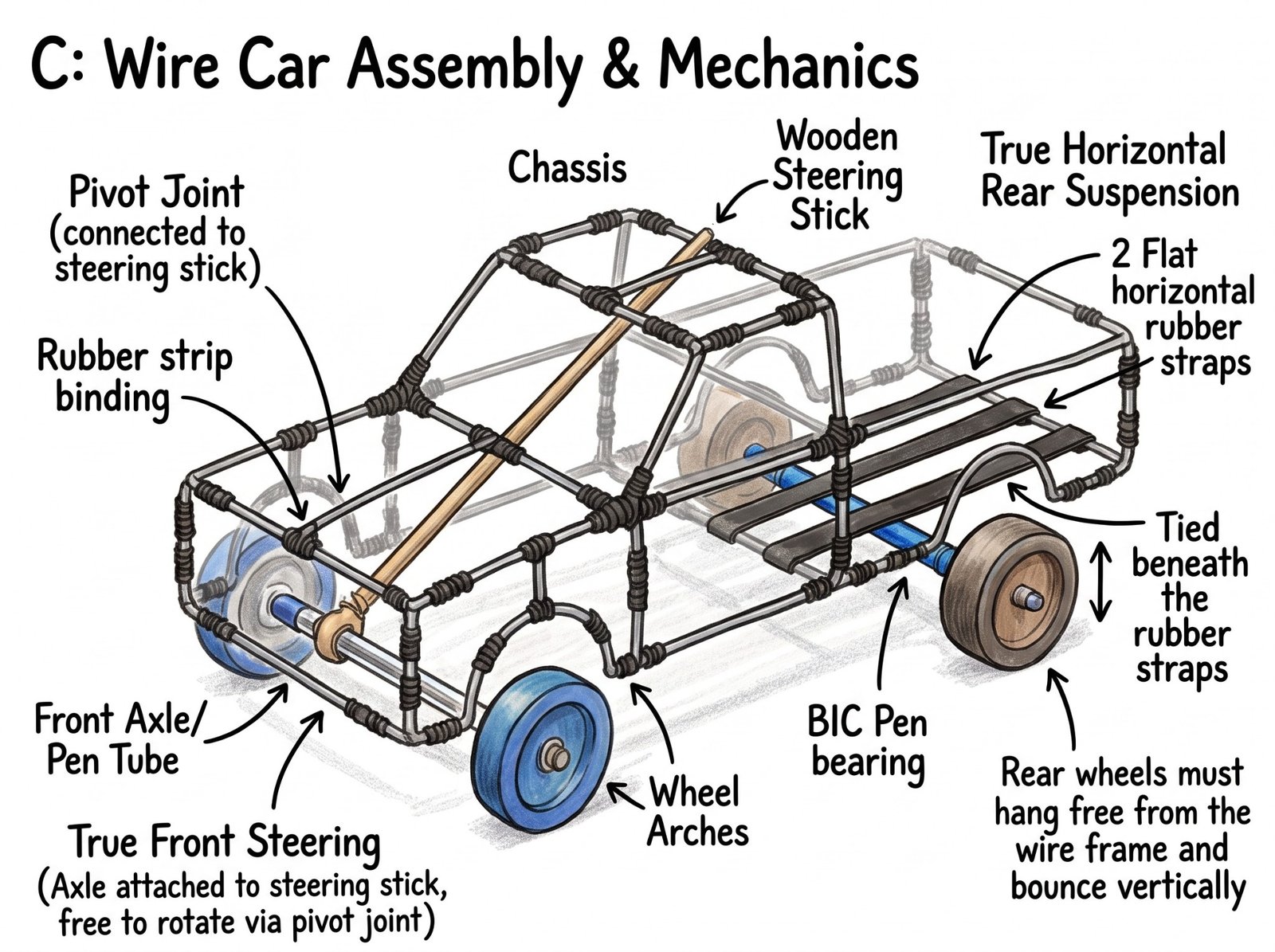
How my wire car worked: a steering stick turned the front axle at a pivot, while two flat, horizontal inner-tube strips supported the rear axle beneath the chassis.
Years later, I learned that full-sized cars also need suspension. Their systems are much more sophisticated, with springs and other parts that help the wheels follow an uneven road. But the basic problem was the same one I had faced as a child: how do you let the wheels move without making the whole car bounce wildly?
My first drive
At last, after all the bending, wrapping, undoing, and trying again, I had something I could hardly believe I had made.
My own wire car.
I put it on the ground, held the steering stick, and pushed it forward. The wheels rolled. I turned the stick, and the car changed direction. When the rear wheels crossed a small bump, the rubber suspension flexed and sprang back.
It wasn’t perfect, but it worked. And I understood every part of it because I had helped turn those ordinary materials into a machine.
When I saw the boys again, I came with my car. This time I wasn’t a shy stranger following at a distance. I was walking beside them, our cars rolling in front of us as we steered them along the road.
I had finally joined the car club.
Part 3: Thinking Like an Engineer
One car led to many others
Building that first car changed the way I played.
Once I understood the wheels, bearings, steering, and suspension, I could use the same ideas to make something different. I changed the shape of the wire chassis to build trucks. Then buses. Every new design gave me another problem to solve, and another reason to experiment.
My new friends shared their tricks with me, and I shared what I had learned with them. We studied one another’s designs, talked about what worked, and tried new ideas. Making things together was even more fun than building LEGO cars alone.
And I began seeing everyday objects in a completely different way. A worn-out sandal wasn’t just rubbish; it might contain four wheels. An empty pen wasn’t useless; it might become a bearing. A strip of rubber could become a spring. Once I knew what a part needed to do, I could start looking for something that could do that job.
Learning to think like an engineer
Many years later, I learned a word for much of what we had been doing: engineering.
Engineers don’t simply put things together. They wonder how things work. They imagine how something could work better. They make a design, try it, discover what is wrong, and improve it.
Looking back, I can see one mistake that made my first wire car much harder to build: I never drew a plan. I kept the entire design in my head and tried to shape the wire until it looked right.
Today, I know how helpful even a simple sketch can be. Engineers draw ideas, make models, build prototypes—early versions that they can test—and learn from what fails. Then they try again. I was already doing the building, testing, and trying again. I just didn’t know how much time a drawing might save me!
But perhaps those frustrating afternoons were useful after all. They taught me patience. They taught me to look closely at a problem instead of giving up. And they taught me something that has stayed with me: if you really want to understand how something works, try building it yourself.
A new world at fourteen
My fascination with cars didn’t end with the wire car. When I was fourteen years old, I received a very special toy: the LEGO Technic 8865.
This was nothing like the ordinary LEGO bricks and wheels I had played with at nine. It was a much more sophisticated model, filled with mechanisms that worked like those in a real automobile.
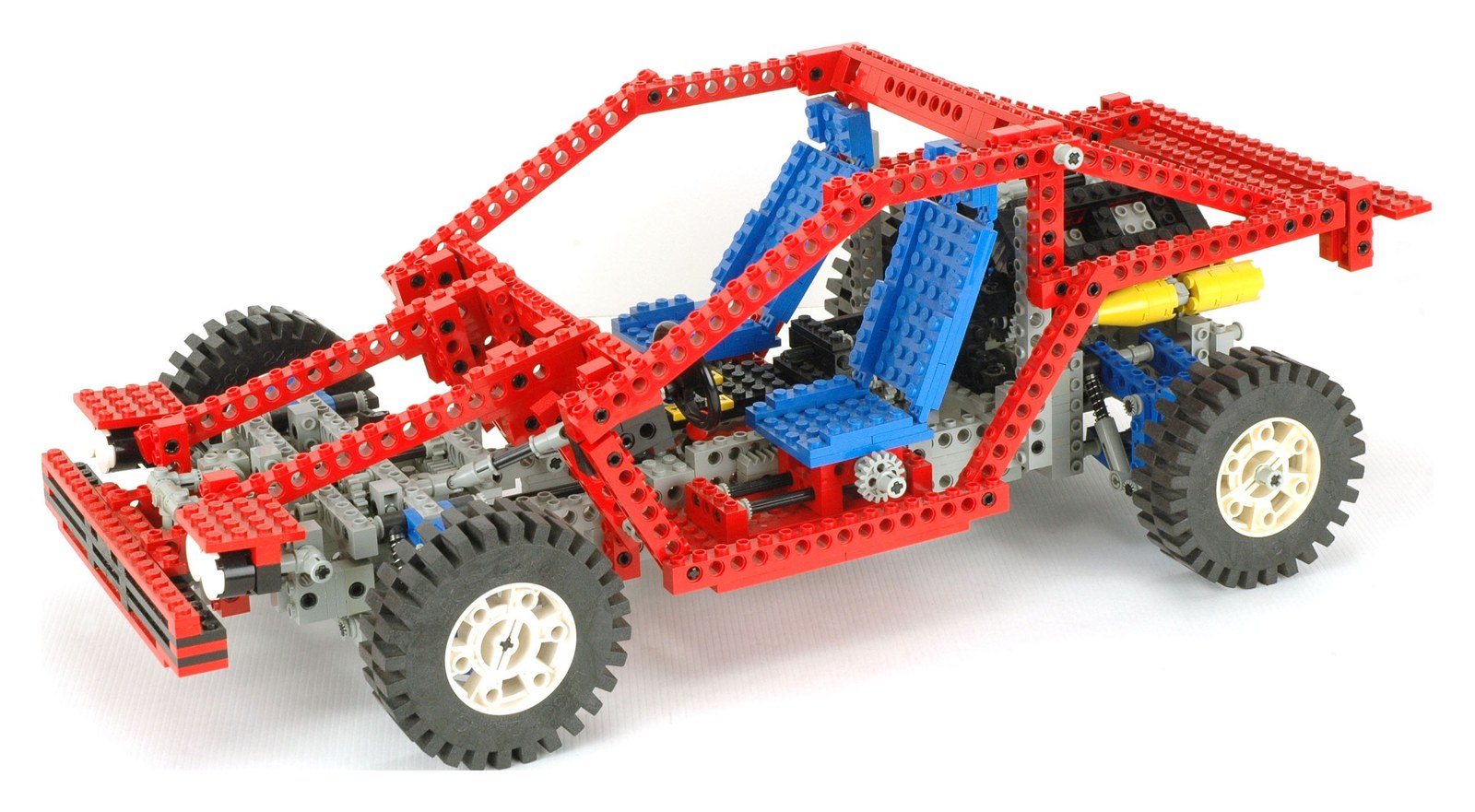
My LEGO Technic 8865 Test Car, featuring a V4 engine with moving pistons and a three-speed manual gearbox.
It had steering mechanisms that guided the front wheels, suspension that allowed the wheels to move over bumps, and a three-speed manual gearbox. It even had a V4 engine, with four pistons that moved up and down as the engine turned, and a differential, a clever mechanism that allowed the rear wheels to turn at different speeds when going around a corner.
I was fascinated. This time, I could put together carefully designed mechanical parts and watch how they interacted. I could follow a movement from one gear to another, turn the steering mechanism, and see what happened. It was like having a little mechanical engineering laboratory at home.
And it made me think about the wire cars we had built years earlier.
We had solved some of the very same problems: how to make wheels turn, how to steer, how to hold the body together, and how to keep bumps from shaking the whole car. Our solutions had been much simpler, but the questions were surprisingly similar.
LEGO Technic took my understanding of cars and mechanical engineering to a new level. I loved that model so much that I have kept it to this day.
The most important thing I learned
When I think back on those years, I remember the LEGO bricks that first let me build my own little cars. I remember the Technic model that later revealed a whole new world of mechanisms.
But I also remember that first afternoon when I watched a group of boys racing handmade wire cars down a road in Cameroon. And I remember the youngest boy walking toward me and handing me his steering stick.
He showed me something I couldn’t learn by looking at my LEGO bricks alone: you don’t always need to have the right parts. Sometimes, you can invent the parts you need.
He also showed me the joy of sharing what you know. Without his kindness, I might have kept watching from far away instead of finding the courage to try.
So the next time you see a toy, a bicycle, a fan, or any other machine, take a closer look. What makes it move? What holds it together? What happens inside when you push a button or turn a wheel?
And then ask yourself an even more exciting question:
“Could I make something like that myself?”
You might not have all the parts. Your first design might not work. You might have to take it apart and start again—perhaps many times.
That’s all right. Curiosity is where the adventure begins.
Words to know
- Axle: A rod that connects a pair of wheels and can turn with them.
- Bearing: A part that supports something while allowing it to rotate. An empty pen tube can make a simple bearing.
- Chassis: The frame, or skeleton, of a vehicle.
- Friction: The resistance that occurs when two surfaces rub against each other.
- Pivot: A joint that allows one part to turn relative to another.
- Suspension: A system that lets the wheels move relative to a vehicle’s body as they travel over bumps.
- Prototype: An early version of something, built to test an idea and discover what to improve.
- Gearbox: A set of gears that changes how turning motion is passed from one part of a machine to another.
Try this: Make something that rolls
With an adult’s help, try building a small car from cardboard, two drinking straws, two wooden skewers, and four bottle caps. Tape the straws beneath the cardboard and slide a skewer through each one. Ask the adult to make the holes in the caps and handle any cutting, then attach a cap to each end of the skewers.
Push the car gently. Watch how the skewers turn inside the straws: you have made your own axles and bearings!
Now try changing one thing. What happens if the wheels are different sizes? What if an axle isn’t straight? Can you make the car roll more smoothly? Before each change, make a guess about what will happen. Then test it.
Look closely. Ask why. Make something. Try again.