The Walking Doll
A true story about a toy with a heartbeat
Published:
Part 1: The Doll with a Heartbeat
When I was ten years old, my little sister got a doll for Christmas. It was a pretty doll, with a dress and curly hair. But that was not what caught my eye: this doll could walk!
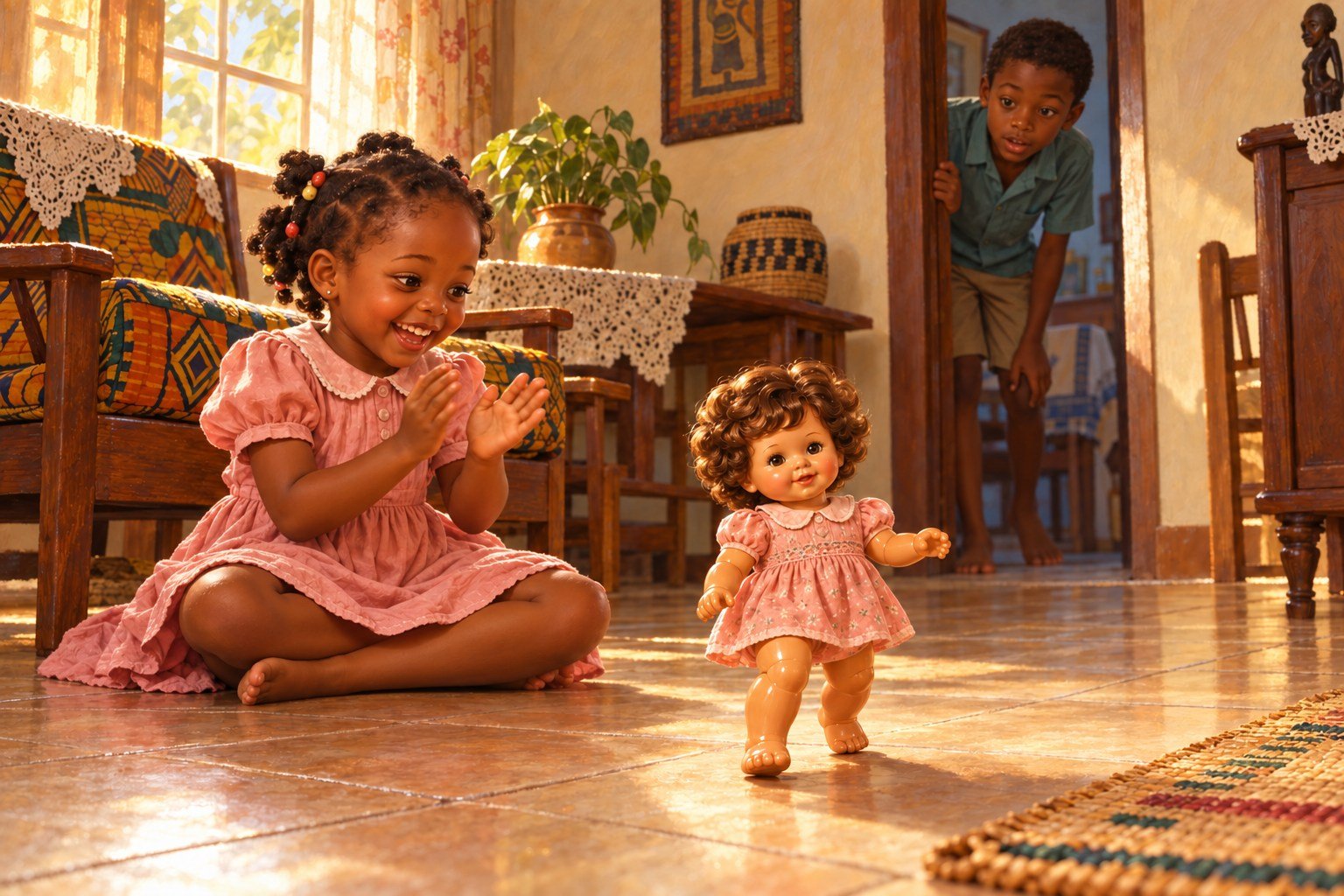
My little sister and her walking doll. I was the one in the doorway. (Painted reconstruction of the scene.)
I had seen plenty of toys before. Dolls that talked. Dolls that cried. Dolls that drank from a bottle. But a doll that put one foot in front of the other and marched across the room all by herself? That felt like science fiction.
I watched her every chance I got. My sister would set her on the floor, flip the switch, and I would stare as she wobbled her way across the room, step after step, without ever falling over. And every time, the same question buzzed in my head: how does she do it?
The longest wait
I wanted to open her up and look inside. But she was not my doll, and breaking my sister’s Christmas present was not an option. So I waited.
I waited for weeks and weeks. Slowly, the doll started to get tired. Her steps got shaky. She would wobble, tip, and fall. And finally, my sister got bored of playing with her. I promised I would try to fix her. That was my chance.
I carried the doll to my room like a surgeon heading to the operating room. I had already opened lots of broken things at home: radios, calculators, alarm clocks. I knew there had to be an electric motor inside, because the doll ran on batteries. Carefully, I unscrewed her body and opened it up.
What was inside
There was the motor, just as I expected. A long rubber belt ran from the motor up to something I did not expect at all: a big, heavy disk mounted at the top of a swinging arm. It was the heaviest part inside the doll, heavier than the motor and everything else put together. And the rubber belt that connected them? It had snapped in two.
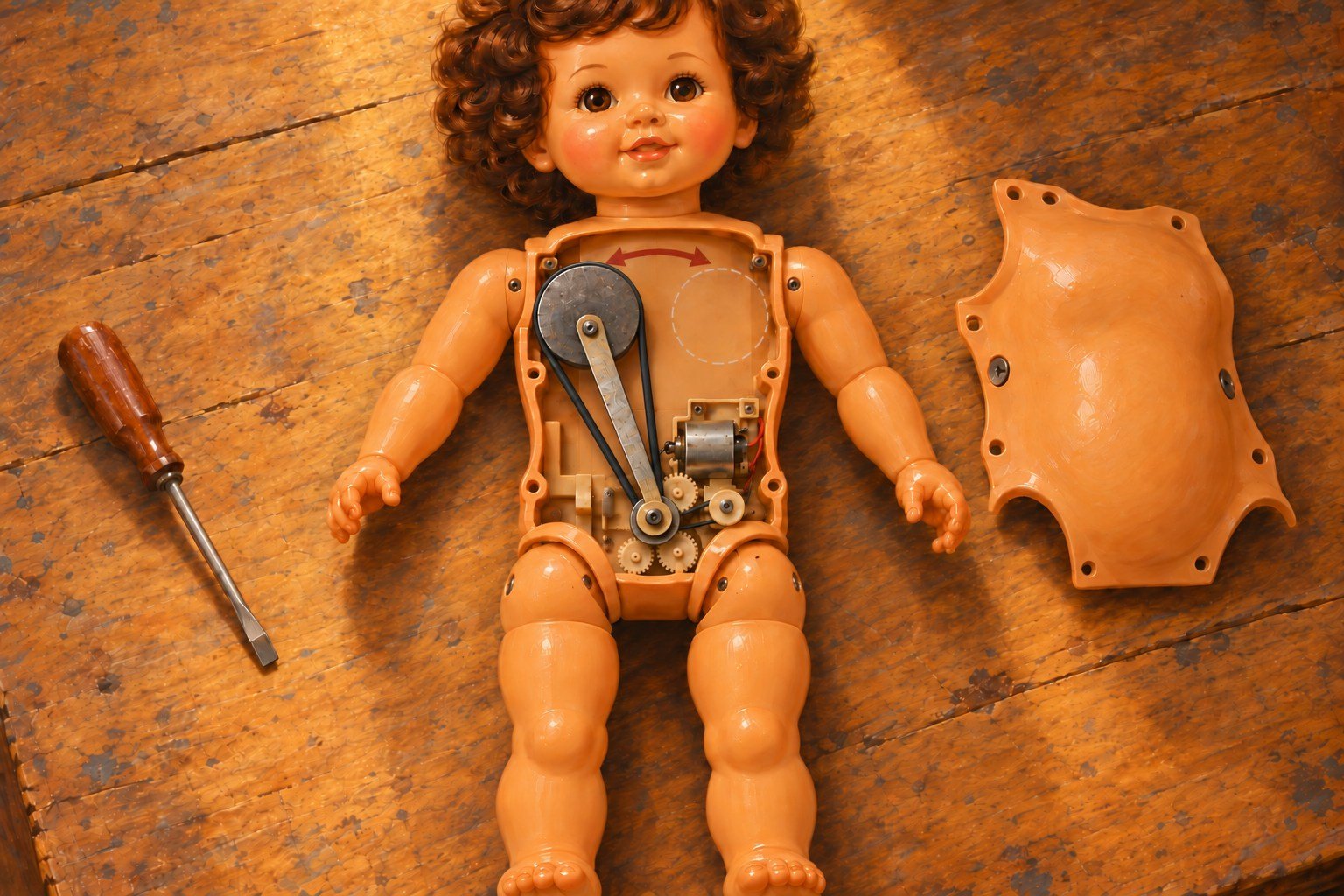
Inside the doll: the motor, gears, the long rubber belt, and the heavy disk on its swinging arm. (Reconstruction based on my sketch.)
When the motor ran, the arm swung the heavy disk to the left, then to the right, then to the left again, and the doll’s weight went with it. And that was the secret.
When the weight swung to the left, the doll leaned onto her left leg, and her right leg lifted off the floor and swung forward. When the weight swung to the right, she leaned onto her right leg, and her left leg stepped forward. Left, right, left, right. The doll never had to think about balance. The heavy disk did it for her.
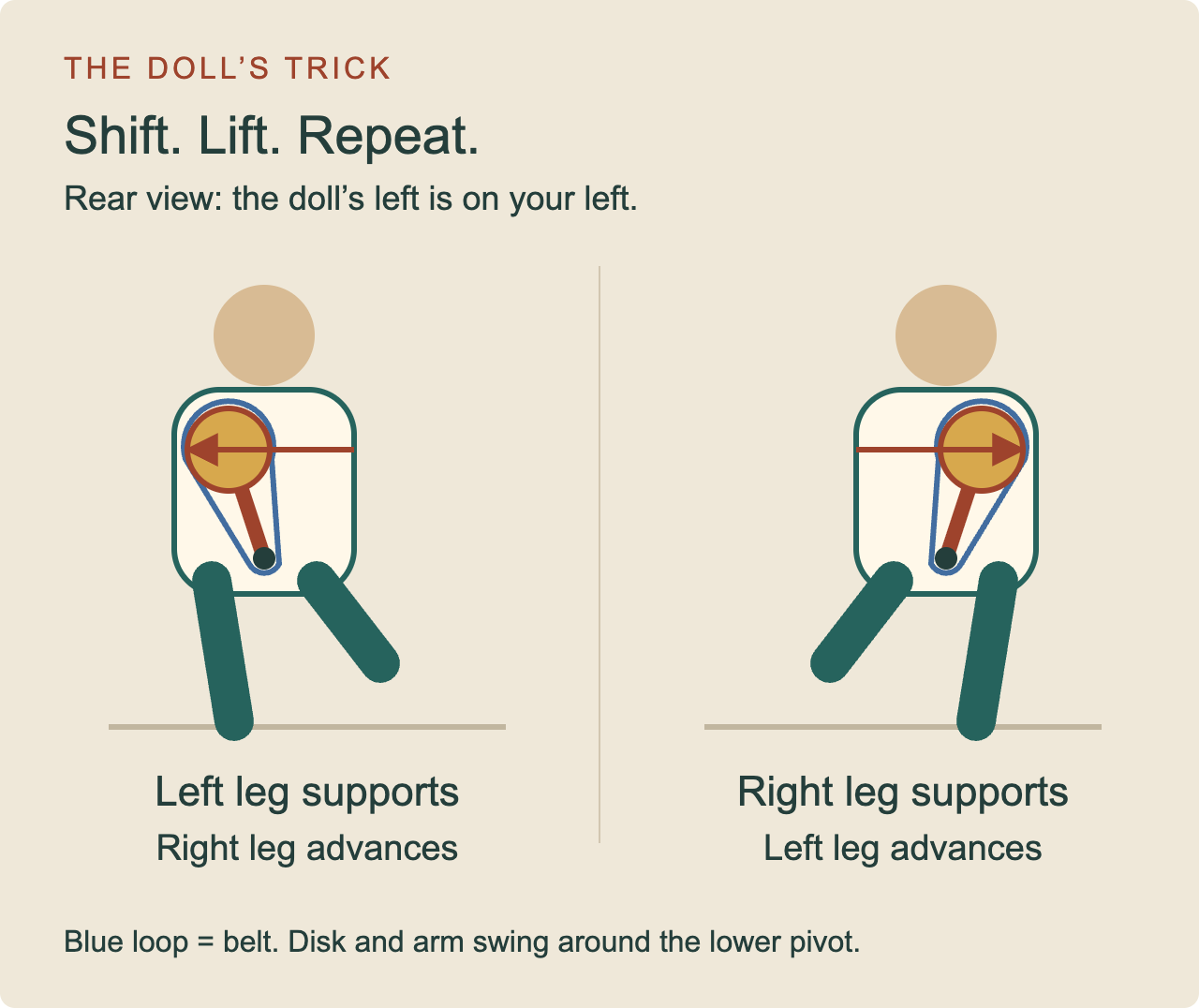
The doll’s trick: shift the weight, lift the other leg, repeat.
The doll’s heartbeat
I could never have guessed that trick on my own. And what amazed me most was how everything inside the doll followed the beat of that heavy disk. The legs, the leaning, the rhythm of every step: they all moved in time with it. The disk was like the doll’s heart.
It reminded me of the old grandfather clocks you sometimes see in museums and old houses, with a long pendulum swinging slowly back and forth behind a glass door. In those clocks, the pendulum sets the beat, and every gear follows it. Today, the chips inside computers and phones also have a “clock”: a tiny electrical signal that ticks billions of times a second, so every part of the chip stays in step. The doll had a clock too. It just happened to be a heavy, swinging disk.
Now I could see what had gone wrong. Without the belt, the doll’s heart had stopped, and so had her walking. I glued the belt back together as well as a ten-year-old could. The doll moved again, but it was never the same. My repair was not good enough to keep the beat steady.
I did not manage to fix the doll. But the doll fixed something in me. For years, I kept wondering about her heavy, swinging heart.
The big question
Did the doll need a heartbeat to walk? And what about us? What keeps our steps in rhythm?
Find out in Part 2.
Part 2: Why Walking Is Hard
You walk without thinking about it. You can walk while talking, eating a sandwich, or looking at your phone. So walking must be easy, right? Not at all. Walking is one of the hardest things your body does.
A baby’s biggest project
Most babies take about a year to learn to walk. First they roll, then they crawl, then they pull themselves up on a table and stand there, wobbling. When they finally let go, they fall. A lot. Toddlers learning to walk fall down again and again every day. Each fall teaches their brain a little more about balance.
Walking is controlled falling
Here is the surprising truth: every time you take a step, you are falling. You lean forward, your body starts to tip over, and just in time, you swing a foot out in front of you and catch yourself. Then you do it again. And again. Walking is a long chain of falls that you catch before they happen.
To understand this, you need to know about your center of gravity. It is the balance point of your body, the spot where all your weight seems to be gathered, somewhere around your belly button. As long as your center of gravity stays above your feet, you stay up. When it moves past your feet, you start to fall.
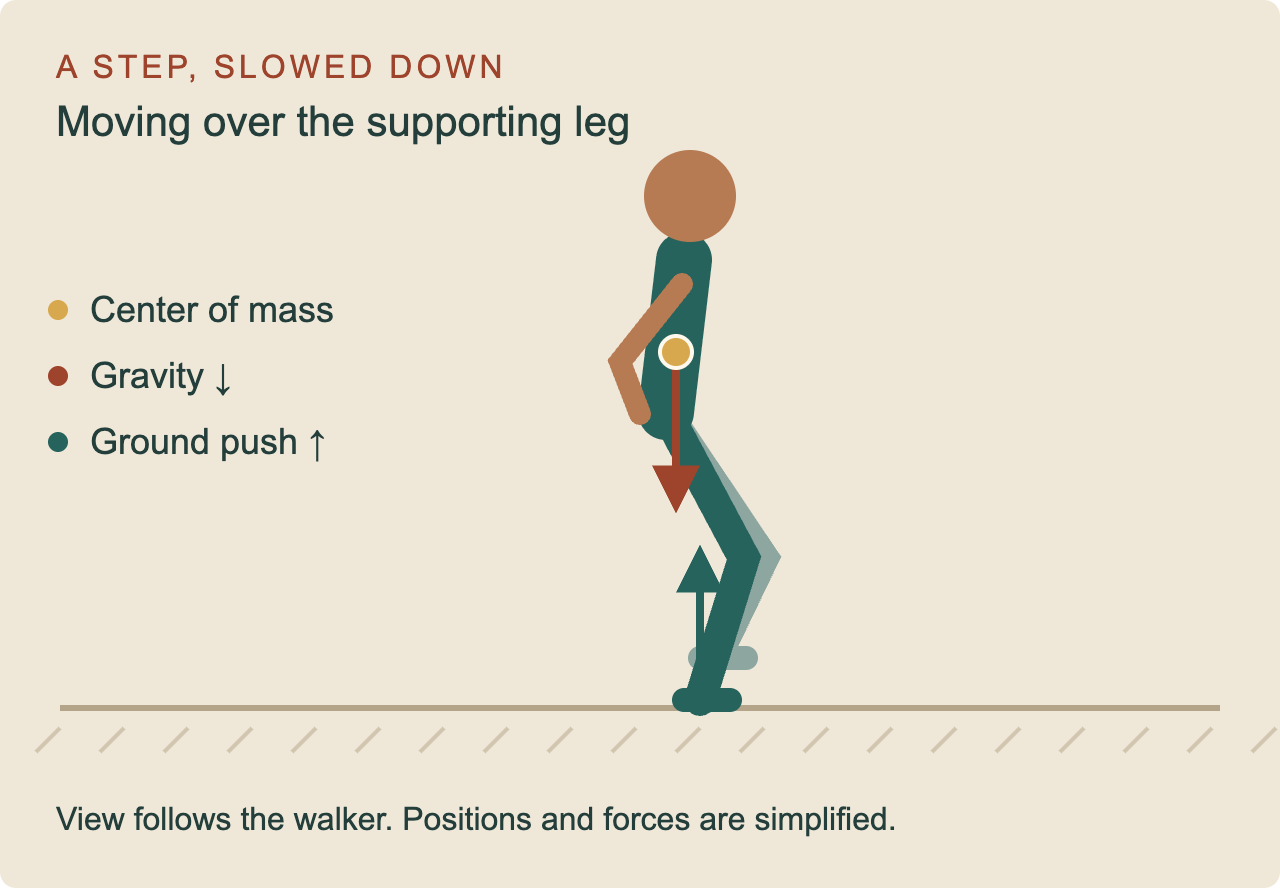
A step, slowed down: gravity pulls your center of mass down, and the ground pushes back up through the foot you are standing on.
Try the doll trick. Stand with your right side pressed against a wall, with your right foot touching the wall. Now try to lift your left foot off the floor. You can’t! To stand on one foot, you have to shift your weight over that foot first, and the wall is in the way. That is exactly what the doll’s heavy disk did: it shifted her weight over one foot so the other one could lift.
Your hidden rhythm-keeper
So what keeps your steps in rhythm? Is it your heart, like the doll?
Here’s something strange. Hold a newborn baby upright with its feet touching a table, and its legs make little stepping movements, months before it can walk. Where does that rhythm come from? Not from the heart. It comes from a small network of nerve cells in the spinal cord, called a central pattern generator. It works like a built-in metronome: it sends out a steady left-right, left-right rhythm to your legs, even when your brain is busy thinking about something else.
Your heart and your steps are still connected, though. When people run, their heartbeat sometimes falls into step with their stride, beating in time with their feet.
Did you know?
Small, quick animals have hearts that race. A mouse’s heart beats about 500 times a minute and a cat’s about 150, while an elephant’s beats only about 30. Scientists explain that this is mostly about size: small bodies use up energy faster, so their hearts must pump faster.
The robot that learned to walk like us
For a long time, walking was too hard for robots. The first walking robots shuffled along very slowly. They kept their center of gravity above one foot at all times, so they would never start to fall. That works, but it is slow and clumsy.
In 1986, the car company Honda started a secret project to build a robot that could walk like a person. It took them fourteen years. In 2000, they showed the world ASIMO, a small white robot that looked like an astronaut. ASIMO could walk smoothly, climb stairs, and later even run, with both feet leaving the ground for a split second.
ASIMO’s trick was careful planning. Before every step, its computer worked out exactly where its weight would press on the floor, and made sure that point always stayed inside the area under its feet. If the point was about to slide outside, ASIMO adjusted its body to stay balanced. It walked with its knees slightly bent, like someone walking on ice, but it walked. When I was at university, I followed every new ASIMO video I could find. It looked like my sister’s doll had finally grown up.
ASIMO retired in 2022, but it opened the door. Robots had learned to walk. Next, they had to learn to handle the real world: rough ground, slippery floors, and a push from behind.
Find out how in Part 3.
Part 3: How Robots Learned to Walk
Today, robots can walk through forests, climb stairs, do backflips, and get back up when someone pushes them over. How did they get so good? Each big step forward came from a clever trick, and many of those tricks are about rhythm.
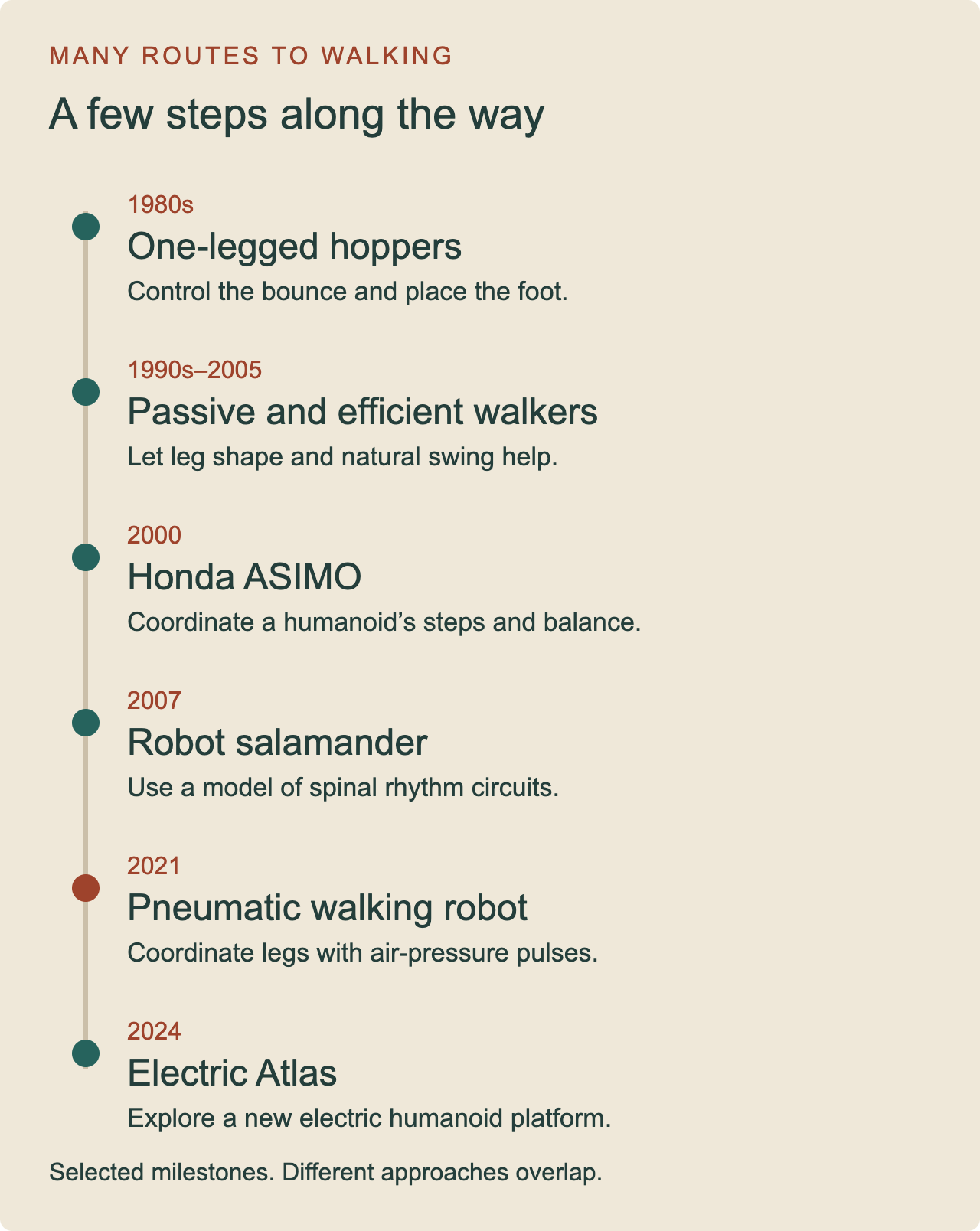
A few steps along the way.
The pogo-stick robot (1980s)
In the 1980s, a scientist named Marc Raibert built a robot with just one leg. It could not walk at all. It could only hop, like a pogo stick. But it never fell over.
The trick: a springy leg that bounces at its own natural rhythm, and one simple rule: if you start to tip, put your foot down a little further in the direction you are falling. Raibert later started the company Boston Dynamics, whose robots, like the dog-like Spot and the humanoid Atlas, still use ideas from that hopping leg.
The robot with no brain (1990s and 2000s)
Some scientists asked a strange question: how much of walking can a robot do with no computer at all? They built legs with knees and hips, set them at the top of a gentle slope, and gave them a little push. The legs walked all the way down, step after step, with no motor and no brain.
The trick: a swinging leg is a pendulum, just like the one in a grandfather clock. If the legs have the right length and weight, gravity swings them at just the right rhythm. Robots built on this idea use very little energy, because the body’s own swing does most of the work.
The robot with a rhythm in its spine (2007)
In Switzerland, Auke Ijspeert and his team built a robot salamander that could swim in water and then crawl out onto land.
The trick: instead of planning every movement, they gave the robot an electronic copy of the central pattern generator from Part 2: a chain of electronic rhythm makers, called oscillators, that keep time together and pass their rhythm down the body. Turning up one signal changed the rhythm from crawling to swimming.
Learning by falling, millions of times (2010s to today)
Remember the toddler who falls again and again? Today’s robots learn the same way, only much faster. Engineers build a copy of the robot inside a computer and let thousands of copies practice walking at once, falling and trying again, millions of times. Each time a copy does a little better, the computer keeps what worked.
The trick: years of practice squeezed into a few hours of computer time. When the lessons are copied into the real robot, it can walk on ice, sand, and stairs, and catch itself when it slips.
Robots that know where they are (Finding the way)
Walking is only half the job. A robot also needs to know where it is going. Robots look around with cameras and lasers that measure distance, and build a map of the room while working out where they are on it, at the same time. Engineers call this SLAM.
The trick: drawing the map and finding yourself on it at the same time, the way you might explore a new school on your first day. NASA’s Perseverance rover uses its cameras to plan its own safe path across Mars, because messages from Earth take many minutes to arrive.
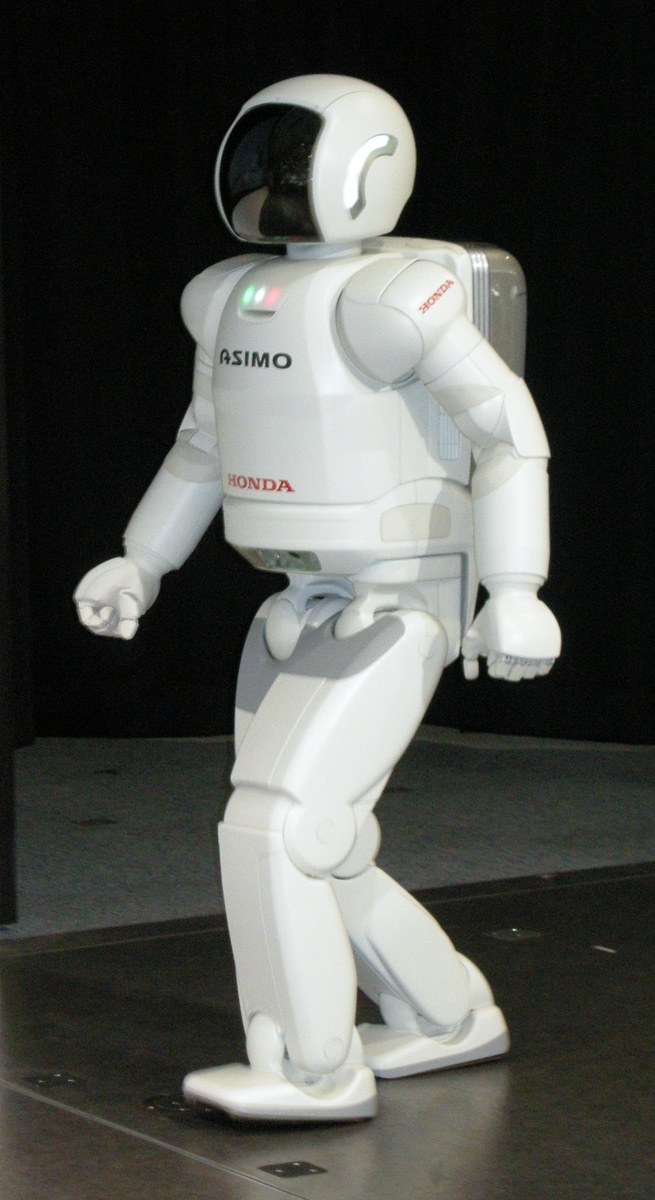
ASIMO walking. Notice its knees: they stay bent the whole time, which helps it keep its balance as it shifts its weight from foot to foot. Photo: Hatsukari715, Wikimedia Commons, public domain.

Why robots matter
Why give robots legs, when wheels are so much simpler? Because our world is built for legs: stairs, curbs, rocky trails, the inside of a fallen building. Wheels get stuck where feet keep going. That’s why walking robots may one day search for people after earthquakes, explore other planets, and help people at home.
The heartbeat question
Today, building robots is my hobby. I build my own little walking machines with LEGO, and every time one of them wobbles and falls, I think about my sister’s doll.
Modern robots keep their balance with sensors and fast computers. Their sensors feel which way the body is tilting and how hard each foot presses on the ground, and the computer checks their posture and corrects it hundreds of times every second. That works amazingly well. But the doll taught me something I never forgot: her whole body moved in time with one heavy, swinging heart. And I often think about cats. A cat’s heart beats about twice as fast as yours, and a cat is one of the quickest, smoothest movers on Earth. Scientists say a fast heartbeat is mostly about body size. But I can’t help wondering whether a fast inner rhythm also helps a quick animal stay in control of its moves.
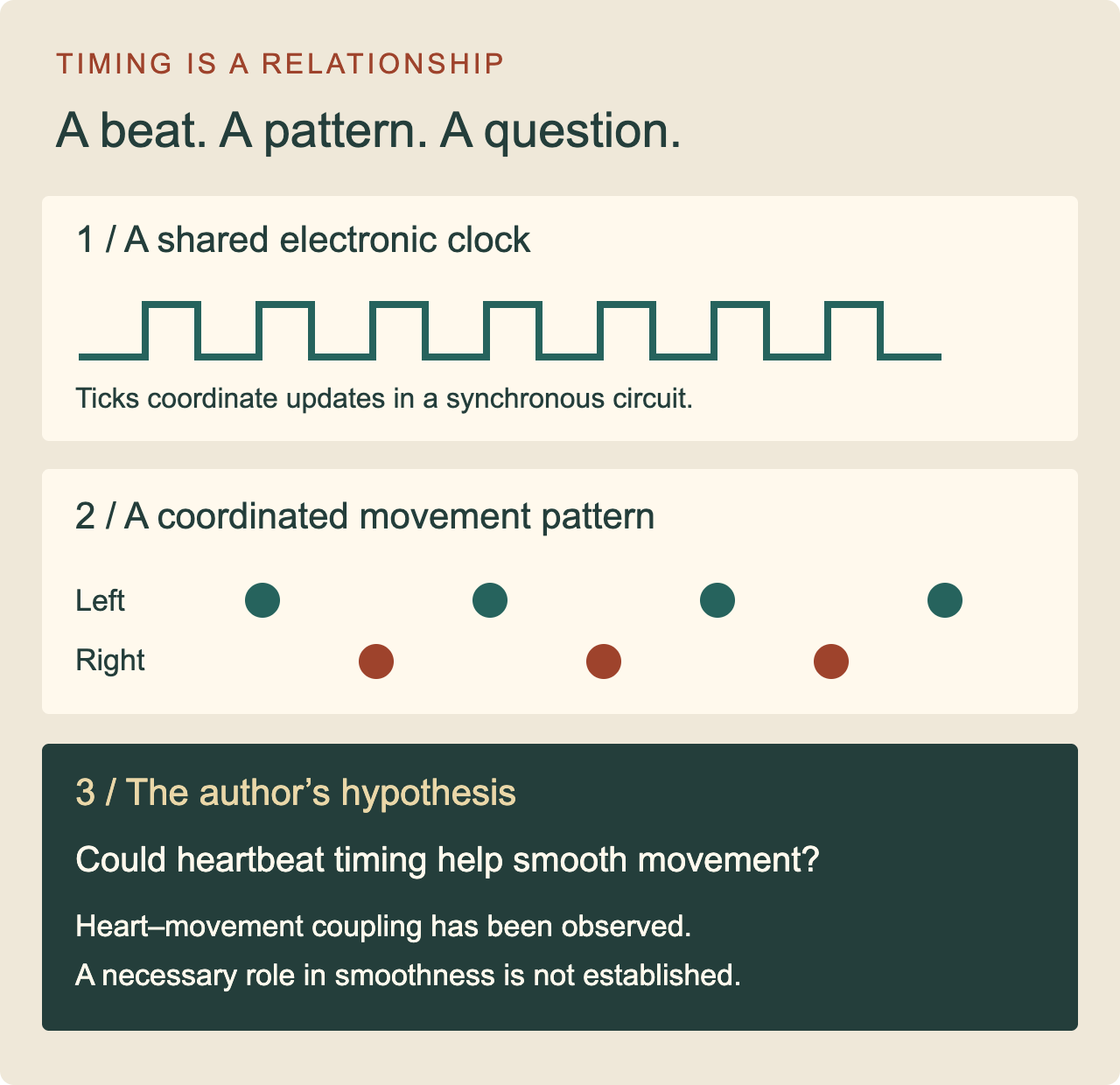
Timing is a relationship: a balance loop, a pattern, and a question.
The big question
So here is the question I still wonder about. Are sensors and quick corrections enough to make a robot move as smoothly as a cat or a dancer? Or will the walking machines of the future need something like a mechanical heartbeat, a real swinging rhythm at their center, that the whole body can move in time with?
I don’t know the answer. Nobody does yet. Maybe you will be the one to find out.
Words to know
Center of gravity: The balance point of an object, where all its weight seems to be gathered.
Pendulum: A weight that swings back and forth at a steady rhythm.
Central pattern generator: A network of nerve cells in the spine that sends out the rhythm for walking.
SLAM: How a robot builds a map and finds where it is on that map at the same time.
Try this
Walk across a room very slowly and notice what your body does just before each foot lifts. Then try walking without swinging your arms at all. Does it feel harder? Your arms swing like pendulums too, in rhythm with your legs.