The Magic of Artificial Intelligence
The secret is in the roads
Published:
Part 1: How a Brain Learns
Briar Glen is an old rabbit village spread across a wide green valley. Families built their homes wherever they found good ground, and over time paths appeared between them. Some became broad and busy, while others remained faint, winding through grass and bushes.
At the far end of the valley stands the carrot bank, where the rabbits store the harvest that must feed the village through winter. Rain is its great enemy. When rain begins, messengers rush toward the carrot bank, and if enough warnings arrive, the guards pull a large cover over the carrots.
This has happened for generations. The same paths have been traveled again and again until a wide, familiar road now leads toward the bank. The rabbits call it the old rain road.
The watchers
Two rabbits watch the sky from hills above the village. Mina watches for rain. Higher up sits Echo, whose unusually good ears allow her to hear distant sounds. Whenever she notices something unusual, she sends messengers toward the carrot bank.
Mina has the old rain road. Echo does not. From Echo’s hill, only faint trails disappear into the grass.
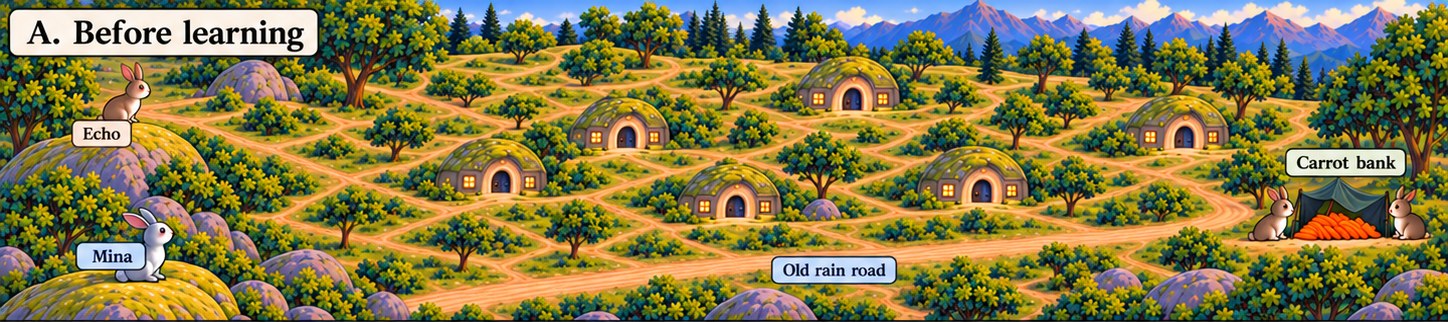 Before learning: the old rain road leads from Mina’s hill to the carrot bank. From Echo’s hill, only faint trails.
Thunder
One afternoon, Echo hears a sound unlike anything she has heard before: BOOM.
Echo does what watchers do when something unusual happens: she sends messengers into the village.
They set off toward the carrot bank, but the way from Echo’s hill is difficult and poorly traveled. Only one or two manage to reach the guards.
The guards do nothing. They hear strange warnings all the time, so their rule is simple: act only when enough warnings arrive.
A few minutes later, Mina feels a drop of rain and sends her messengers. They race down the old rain road, and soon enough warnings reach the carrot bank for the guards to cover the carrots before the rain begins to fall heavily.
To the rabbits, the two events seem unrelated. First came the strange boom. Later came rain.
It happens again
Days later, Echo hears the same sound again: BOOM.
She sends her messengers toward the carrot bank, but the journey is still difficult and only a few reach the guards. A little later, rain begins. Mina’s messengers race down the old rain road, enough warnings arrive, and the guards cover the carrots.
The pattern repeats over the following storms. Thunder comes first, Echo sends her messengers, and rain follows soon afterward.
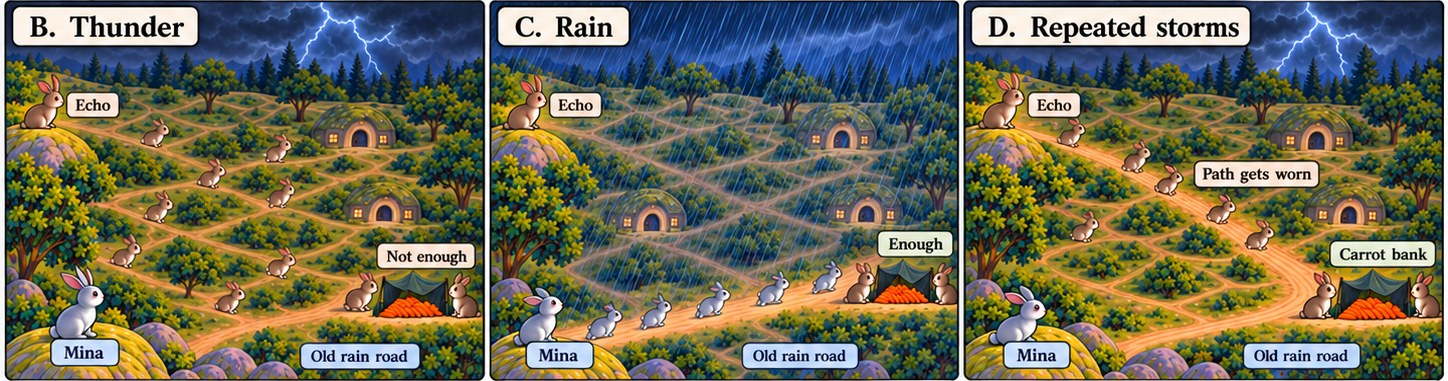 B: After thunder, Echo’s messengers set off, but not enough reach the carrot bank. C: When rain begins, Mina’s messengers race down the old rain road, and enough arrive. D: Storm after storm, the trail from Echo’s hill gets worn.
Running changes the ground
Each time thunder returns, Echo’s messengers travel through the village again. The first journeys leave almost no trace, but repeated travel slowly changes the ground. Faint traces become trails, trails become clearer paths, and those paths become easier to follow.
Storm after storm, the route from Echo toward the carrot bank grows easier and faster.
Then one afternoon, thunder rolls across the valley again. Echo sends her messengers, but this time they move quickly. A path that once disappeared into the grass is now easy to follow, and many more messengers reach the carrot bank.
Enough warnings arrive, so the guards pull the cover over the carrots.
But Mina has not sent a single messenger. It is not raining yet.
A few minutes later, the first drops fall. The carrots are already safe.
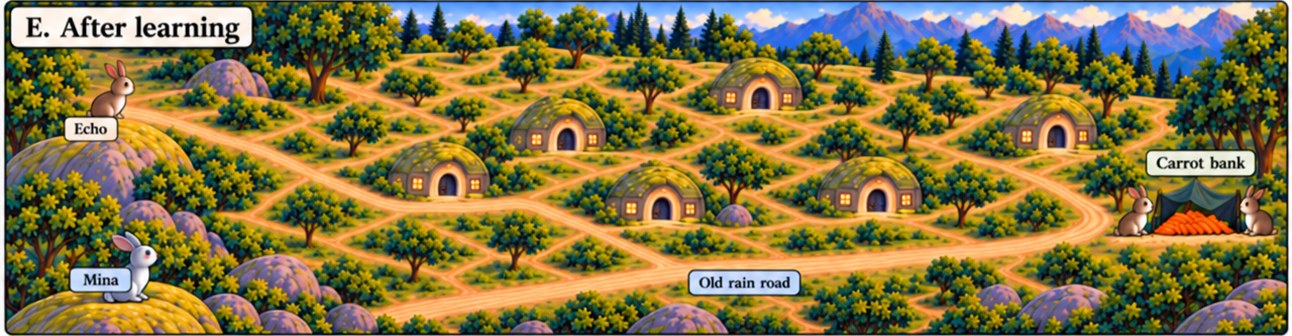 After many storms: the trail from Echo’s hill has grown wider and joins the old rain road to the carrot bank. Compare it with the first picture.
Nobody taught the village
Something remarkable has happened. Briar Glen now behaves as though it knows that thunder predicts rain, but nobody taught it.
Echo still does what she has always done: when she hears something unusual, she sends messengers. Mina still waits for rain. The guards still follow the same rule: if enough warnings arrive, act.
No rabbit ever announced that thunder means rain is coming, and no rabbit deliberately built a new road. The world simply kept repeating the same pattern: thunder, then rain. Each time thunder returned, Echo’s messengers traveled through the village again, and their repeated journeys slowly changed the paths.
Those changed paths altered how quickly warnings could reach the carrot bank. Eventually, the warnings triggered by thunder became enough to make the village prepare for rain.
The relationship was never written down. It emerged from experience.
And where is this new knowledge stored?
In the roads.
Now remove the rabbits
Imagine that the rabbits’ homes are neurons, the cells that process information in your brain. The paths between them are synapses, the connections through which neurons influence one another. The messengers are signals traveling through those connections.
The guards’ rule is also roughly like what a neuron does. Many signals may arrive, but the neuron responds only when their combined influence becomes strong enough.
A real brain is vastly more complicated than Briar Glen, but the central idea is important:
Experience can change connections, and changing connections can change how a network responds.
Your brain is not a hard drive
It is tempting to imagine learning as saving files inside your head: learn a word, save a file; learn to ride a bicycle, save another; learn a language, fill another folder.
But your brain does not work that way. Learning changes the network itself.
Your brain contains roughly 86 billion neurons connected in an enormous web. Some connections become stronger with experience, others become weaker, new connections can form, and others can fade. Scientists call this ability to change neural plasticity.
In a sense, experience keeps redrawing the roads.
Sleep is part of this process too. While you sleep, your brain replays what you learned during the day and strengthens the important parts. That is why an all-night study session is a poor trade: you gain a few hours of studying and lose the part of the night that makes the studying stick.
Think about reading
Think back to when you first learned to read. A word that now takes a fraction of a second once required several steps: recognizing the letters, remembering their sounds, combining those sounds into a word, and connecting the word to its meaning.
Today, you can look at a sentence and understand it almost immediately.
The sentence did not become easier. Your brain became better at processing it.
The same happens when you learn to type, swim, ride a bicycle, speak another language, or play an instrument. At first, every step requires attention. With practice, the network changes. Like the paths in Briar Glen, routes used again and again become easier to travel, and what once felt difficult begins to feel natural.
You know more than you can explain
You can recognize a friend’s face instantly, yet struggle to explain exactly how you recognize it. You may hear that a sentence sounds wrong without knowing which grammar rule it breaks.
Some knowledge is not stored as a rule you can recite. It is built into how the network responds.
Briar Glen is the same. No rabbit can point to a written rule saying that thunder predicts rain.
Learning from patterns
Nobody taught Briar Glen that thunder predicts rain. The pattern simply kept happening, and the village changed.
Humans learn many things this way too. A baby hears thousands of sentences before anyone explains grammar. A child learns to recognize faces, voices, emotions, and movements through repeated experience.
Of course, people also learn from teachers, explanations, books, and deliberate practice. The brain has many ways to learn. But Briar Glen shows us one important possibility:
Patterns in the world can reshape a network even when nobody explicitly teaches the rule.
By the time you are a teenager, your brain has been shaped by years of voices, faces, movements, mistakes, successes, books, conversations, and surprises. Those experiences are not simply stored like files on a disk. They helped shape the network you now use to understand what comes next.
And that raises a remarkable question: if a living brain can learn by changing its connections, could we build an artificial network that learns by changing its connections too?
The answer turned out to be yes.
And that is where the magic of artificial intelligence begins. Next: how to build a brain out of numbers, why chatbots can be confidently wrong, and how to keep your own brain in charge.
Words to know
- Neuron: A brain cell that receives and sends signals.
- Synapse: A connection through which one neuron influences another.
- Neural plasticity: The brain’s ability to change through experience.
Try this
Think of something you can now do almost automatically, such as reading, tying your shoes, typing, throwing a ball, or riding a bicycle. Now try to describe every tiny step involved.
Hard, isn’t it?
Some knowledge is not something you recite. It is built into the roads.
Part 2: How a Machine Learns
In Part 1, a village of rabbits learned that thunder predicts rain. Nobody taught them. The roads between their houses simply changed with every storm. Your brain learns the same way: experience changes the connections between neurons. Now let’s build one out of numbers.
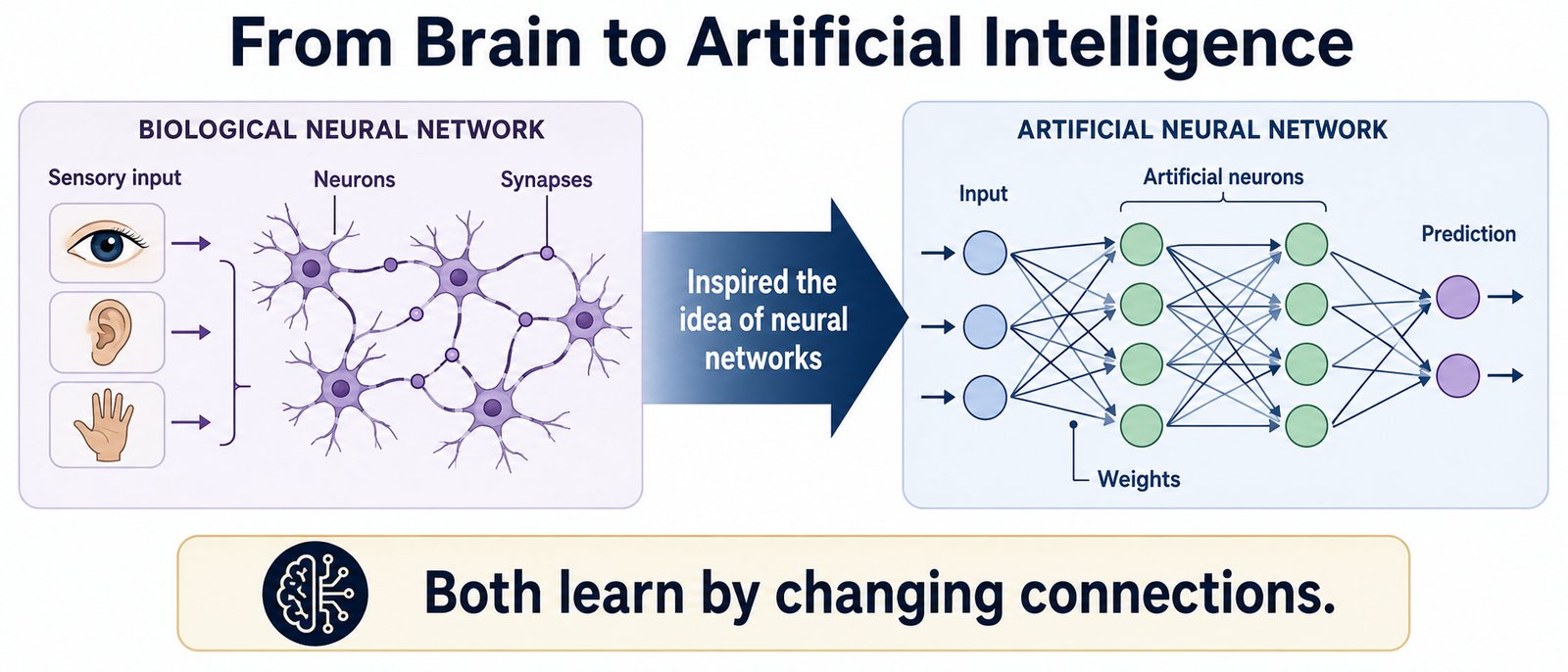 A brain and an artificial neural network are built from very different parts, but both learn by changing connections.
A neuron made of math
An artificial neuron is not a living cell. It is a small calculation. It takes in some numbers, multiplies each one by another number called a weight, adds everything up, and passes the total through a simple rule that decides how strongly it “fires.” Connect millions or billions of these together and you have an artificial neural network.
The weights are the roads of the rabbit village. A big weight means one part of the network strongly influences another. A small weight means a faint connection. And here is the key idea: learning means changing the weights.
Learning by making mistakes
Early attempts at artificial intelligence tried to write down rules. If this happens, do that. Rules are useful, but the real world is far too messy to describe with a list of instructions. Try writing the rules for recognizing a cat in a photo.
Machine learning takes a different approach. Instead of being told the rules, the network is shown examples and adjusts itself when it gets things wrong.
Go back to the rain. Feed the network measurements: how loud the sky is, how dark, how humid. Ask it to predict “rain” or “no rain.” If it guesses wrong, a training program works out which weights contributed to the mistake and nudges them so the next guess is a little better. Repeat this thousands or millions of times, and the network can predict rain without anyone ever telling it that thunder matters.
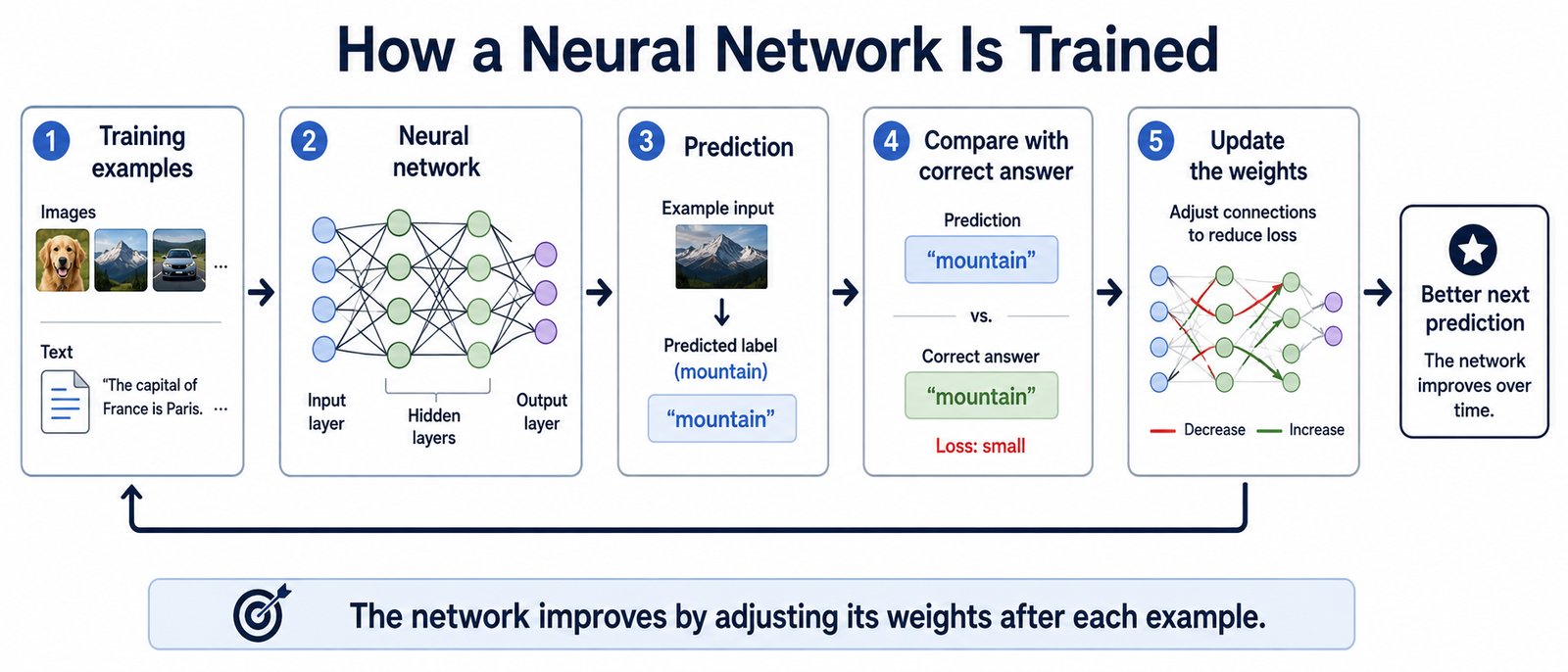 Training a network: show an example, make a guess, compare with the right answer, adjust the weights, repeat.
Peek under the hood
An artificial neuron is just a weighted sum. Suppose our rain neuron has three inputs, each equal to 1 if true and 0 if false, and three weights it learned during training:
rain score = 0.8 × thunder + 0.5 × dark clouds + 0.1 × humid air
- Thunder and dark clouds, but dry air: 0.8 + 0.5 + 0 = 1.3. That is above the threshold of 1, so the neuron fires: rain.
- Humid air only: 0.1. Far below 1, so no rain.
Training changed nothing about the formula. It only changed the three weights. The weight on thunder started near 0 and grew to 0.8 because thunder kept showing up before rain, exactly like the rabbits’ shortcut wearing into a path.
Chatbots learn through an even simpler game. Show the network part of a sentence and ask it to guess the next word. Compare the guess with the real next word. Adjust the weights. Do this on a mountain of text, and the network gradually learns grammar, facts, styles, and even how to explain a chemistry problem. No teacher labels anything. The patterns in language provide the lessons, just like the storms taught the rabbits.
Why it happened now
The ideas behind neural networks are decades old. For a long time, computers were too slow and there was not enough data. Then three things changed at once. The Internet produced enormous piles of text and images. Computers got dramatically faster. And graphics chips, originally built for video games, turned out to be perfect for the kind of math that networks need. In 2012, a network called AlexNet used those chips to win an image recognition contest by a huge margin. In 2017, a new design called the transformer made it practical to train networks on almost unimaginable amounts of text. Today’s chatbots are its descendants.
Not a library, not a brain
So a chatbot is not a giant library with a prepared answer to every question. It is a network of billions of weights, shaped by predicting text. When you ask it something, it builds a reply one word at a time. That is why it can answer a question nobody has ever asked in exactly that way. It has learned patterns it can recombine.
It is also not a brain. A neuron is a living cell. An artificial neuron is a calculation. Your brain grew through a body, senses, feelings, and friendships, and it keeps rewiring itself every day. A chatbot’s weights are frozen once it is released. Talking to it does not change it.
The catch
Because the network learns from examples, it can learn the wrong thing. Imagine someone in the rabbit village started banging a drum on sunny days. The drum messengers would race down Echo’s wide road, and the rabbits would cover the carrots for nothing. The village cannot tell a drum from thunder.
Computer scientists have an old saying: garbage in, garbage out. A network trained on badly labeled photos learns the wrong categories. A network trained on biased text can repeat the bias. And a chatbot can give you an answer that sounds smooth and confident while being completely false. That is not a mystery. Its training rewards text that sounds right, not text that has been checked against the truth. Sounding fluent proves the words fit a pattern. It does not prove they are true.
The same catch applies to you
Here is where artificial intelligence becomes a lesson about human intelligence.
Your brain also learns from whatever reaches it: teachers, friends, books, videos, and social media. Most of what you know, you learned from someone else. That is normal and necessary. But a source can be sincere and still be wrong, and hearing something many times does not make it true.
Psychologists call one of our biggest traps confirmation bias. Once you believe something, evidence that agrees with you feels convincing, and evidence that disagrees is easy to ignore. In the language of the village, some roads become so familiar that your thoughts always take them. Critical thinking means deliberately exploring the roads you would normally skip.
It helps to separate what you saw from what you concluded. “She walked past me without saying hello” is an observation. “She walked past me because she doesn’t like me” is an interpretation. The interpretation might be right, but it needs more evidence.
So when something matters, ask three questions. Where did this come from? Is there a second source that says the same thing? What would make me change my mind? Apply those questions to your teachers, to this article, and especially to AI. If a chatbot gives you a source, open the source. Do not just trust the citation.
Keep your brain in charge
AI can explain a math problem, summarize a chapter, fix your essay, or write code in seconds. That is extraordinary. But there is a danger hidden inside the convenience. A machine can hand you the answer without giving you the experience that would have changed your brain. Remember: the sentence did not get easier, your brain got better. The struggle is often the part that builds the wiring.
So use AI as a tutor, a critic, and a tool. Ask it to explain something a different way, quiz you, or point out the weak spots in your argument. And sometimes close it, wrestle with the problem yourself, and make sure the understanding belongs to you.
Nobody knows which AI tools will matter in ten years. The best preparation is not mastering one app. It is becoming very good at learning new things, and knowing enough about a subject to notice when a machine is wrong.
The real magic
Artificial intelligence may be one of the most important technologies of your lifetime. But its most interesting lesson is an old one. What we learn depends on what reaches us, how we process it, and whether we stay willing to learn again.
Maybe that is the real magic. Not a spell, but the remarkable fact that patterns, repetition, and changing connections can produce abilities that no single part possesses alone. A rabbit village can learn to predict rain. A pile of numbers can learn to write. And a teenager with a curious, well-rested brain can learn almost anything.
Stay curious. Keep asking questions. And whenever the evidence demands it, do not be afraid to build a better road.
Words to know
- Weight: a number that controls how strongly one artificial neuron influences another. Training changes the weights.
- Training: showing a network many examples and adjusting its weights each time it makes a mistake.
- Confirmation bias: the habit of noticing evidence that supports what you already believe and ignoring evidence that does not.
Try this
Ask an AI chatbot a factual question about something you know well, such as your favorite sport or a historical event. Then check its answer against a trusted source. Did it get everything right? Did it sound confident anyway?