The Day My Plane Crashed
A true story about learning to fly
Published:
I was born in Cameroon, in West Africa, where the sky in the dry season looks impossibly high and blue. Sometimes an airplane would cross that sky: tiny, silver, and loud. I would stop whatever I was doing and stare. How did it stay up there? What kept it from falling?
By age six, I knew how to fold paper airplanes and fly kites with the kids in my neighborhood. Paper planes were fun but unpredictable: they dove and crumpled. Kites, when the wind was strong and I kept steering the line, tugged at the sky like birds. I knew the wings mattered (paper wings, kite wings, real airplane wings), but I didn’t yet know why.
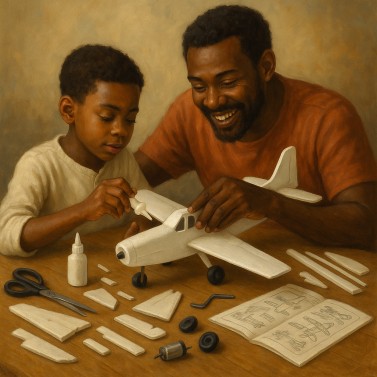 Saturday afternoons: one step at a time.
One Christmas, I opened a present that changed everything. Inside were small packets: a body (called a fuselage) cut from a sheet of foam, a wind-up motor powered by a spring and a little key, a plastic propeller, two front wheels and one back wheel, colorful stickers, a tube of glue, and an instruction booklet full of pictures.
It was a big project for a small kid, so my dad helped me every Saturday afternoon. Week 1: glue the fuselage. Week 2: attach the wings and wheels. Week 3: install the motor and decorate, with lightning bolts and a slightly crooked star. We worked slowly and carefully, one step at a time.
When the plane was finally ready, we took it to the backyard. Here’s how a launch worked: insert the key, wind the motor while holding the propeller still, feel the spring tighten, then let go and give the plane a gentle toss. A long string, called a control line, was tied to the tail. It let me steer the plane like a kite, while the spinning propeller pulled it forward.
My dad launched the plane with a firm toss. The propeller buzzed to life, and the little plane shot forward and climbed into the air. Higher and higher it went, all the way above the roof of our house. My heart was pounding. It was flying!
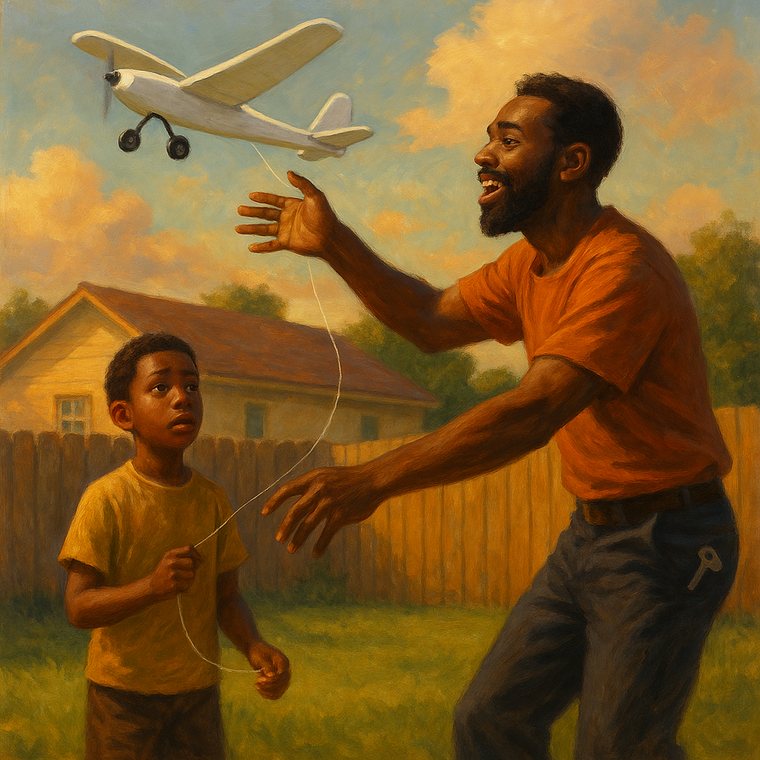 The launch, a few seconds before the crash.
Then the control line in my hand pulled tight as the plane tugged away. I should have run along with it to keep it flying. Instead, I froze. I had waited weeks for this moment, and now I was too excited and too scared to move. “Blaise, move! Blaise, move!” my dad shouted.
I didn’t move. The plane dipped, then dove straight down onto the hard ground. It broke with a loud crack, like a piece of chalk snapping, and the wings crumpled into pieces too small to fix. No amount of glue could save it. That could have been the end of my flying days. Instead, it was the beginning.
Every summer after the crash, I tried again. I borrowed wheels from my sisters’ toys. I asked the shopkeeper for empty chocolate boxes (back then in Cameroon, Mambo chocolate bars came in foam boxes), and I cut new fuselages from the lids. I trimmed wings with dull scissors, bent wire into axles, and glued on decorations for good luck. But every summer ended the same way: a short hop, then a sad nosedive.
The Science of Flight
Years later, in middle school, I visited the public library and found something that changed how I thought about flying. On a dusty shelf was a worn-out magazine for model airplane builders, full of plans, building guides, and photos of proud kids standing next to planes they had made. At the back was a section called “The Science of Flight.” Those pages answered the questions I had been asking for years and showed me what I had been doing wrong.
In simple words written for young builders, it explained the four forces that act on every aircraft, from paper gliders to jumbo jets:
- Thrust: The force that pushes the plane forward. In my models, the wound-up spring turned the propeller, which pushed air backward and moved the plane ahead.
- Drag: The air pushing back against the plane as it moves. Bulky, rough shapes create more drag and slow the plane down. Smooth, sleek shapes slip through the air more easily.
- Lift: The upward force that holds the plane up. It comes from air flowing over and under the wings. To fly, a plane needs enough lift to beat its weight.
- Weight: The pull of gravity on the whole plane. The lighter the plane, the less lift it needs to fly.
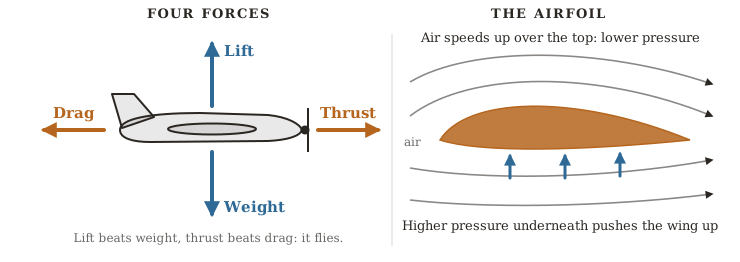 The four forces on a model plane (left), and how a curved wing makes lift (right).
But the biggest surprise was the airfoil, the special shape that makes wings and propellers work. A good wing is not just a flat board. It is curved: rounder on top and flatter on the bottom. As the wing moves, air speeds up over the curved top, and the pressure there drops below the pressure underneath. That difference pushes the wing up. Propeller blades work the same way: each blade is a small, twisted airfoil that grabs the air and pulls the plane forward. My old planes had flat wings and flat propellers, so they never really had a chance.
Flying at Last
Excited, I ran home to fix my design. I carefully shaped gentle curves into the tops of the wings and kept the bottoms flat. I twisted the propeller blades so they would grab more air, smoothed every edge to reduce drag, trimmed extra weight from the fuselage, and adjusted the balance so the plane wouldn’t nosedive. With my heart racing, I wound the spring tight, took a deep breath, and launched it.
It didn’t blast off like a rocket. It glided smoothly into the air. The propeller hummed, the wings held the breeze, and the control line buzzed in my hand as I jogged along, steering it in wide, gentle circles. For a few amazing seconds, my plane and I were flying together. That day I learned something important: science helps us understand the world and turns curiosity into discovery. Ask a question. Change one thing at a time. Test it. Look carefully at what happens. Then try again. The crash in our backyard wasn’t a failure after all. It pointed me toward engineering and the joy of figuring out how things work.
Later, I read about the Wright brothers, Orville and Wilbur, who made the first powered, controlled airplane flights in 1903. Their success wasn’t magic. It came from years of careful experiments: they watched birds fly, tested kites and gliders, built their own wind tunnel to study how air moves around wings, and kept improving their wings, propellers, and controls until their airplane could fly and turn. Their story taught me that every invention is built on big ideas, good tools, and lots of persistence.
Today’s big mysteries have new names: artificial intelligence, computers, and the code of life inside every living thing. But the way to solve them is the same one that taught me to fly: observe, ask questions, test, and try again. That is how discovery works. Everyone has their own version of flight, an idea that seems impossible but fills you with wonder.
Find yours. Wind the spring. Shape the wings. Take a breath. Throw.