The Tree of Life
How every living thing belongs to one big family
Published:
Part 1: The Secret Hiding in Plain Sight
Get ready. Some of these are going to sound made up. They are all true.
- Pigeons are dinosaurs. Not like dinosaurs. Real ones. Birds are the only dinosaurs that never went away.
- Carrots used to be purple. The first carrots people grew were purple or yellow. Orange carrots came much later, from farmers in the Netherlands about 400 years ago.
- Snakes used to have legs. Their great-great-great-grandparents were lizards that walked.
- You once had a tail. Before you were born, when you were about the size of a grain of rice, you had a little tail. It went away.
How can a wolf turn into a poodle? How can a lizard lose its legs? The answer is one of the most amazing ideas people have ever had. And the funny thing is, it was right in front of us for thousands of years.
From wolf to poodle
A long, long time ago, more than 15,000 years ago, some wolves started hanging around people’s camps. The calmest, friendliest wolves got scraps of food. People let them stay. Their puppies grew up near people too.
Then people started choosing. They picked the pups they liked best, and only those got to grow up and have pups of their own. Fast runners for hunting. Big, brave ones for guarding. Tiny, cuddly ones for laps. Each time, the pups looked a little more like what people wanted, and a little less like wolves.
Do that for thousands of years, and you get a Chihuahua, a Great Dane, and a fluffy poodle. They all look different. But inside, every one of them is still a wolf’s great-great-great (keep going for a very long time) grandchild.
Farmers did it too
People did the same thing with plants. Every year, farmers saved seeds from their best plants: the biggest, the sweetest, the tastiest. Little by little, the plants changed.
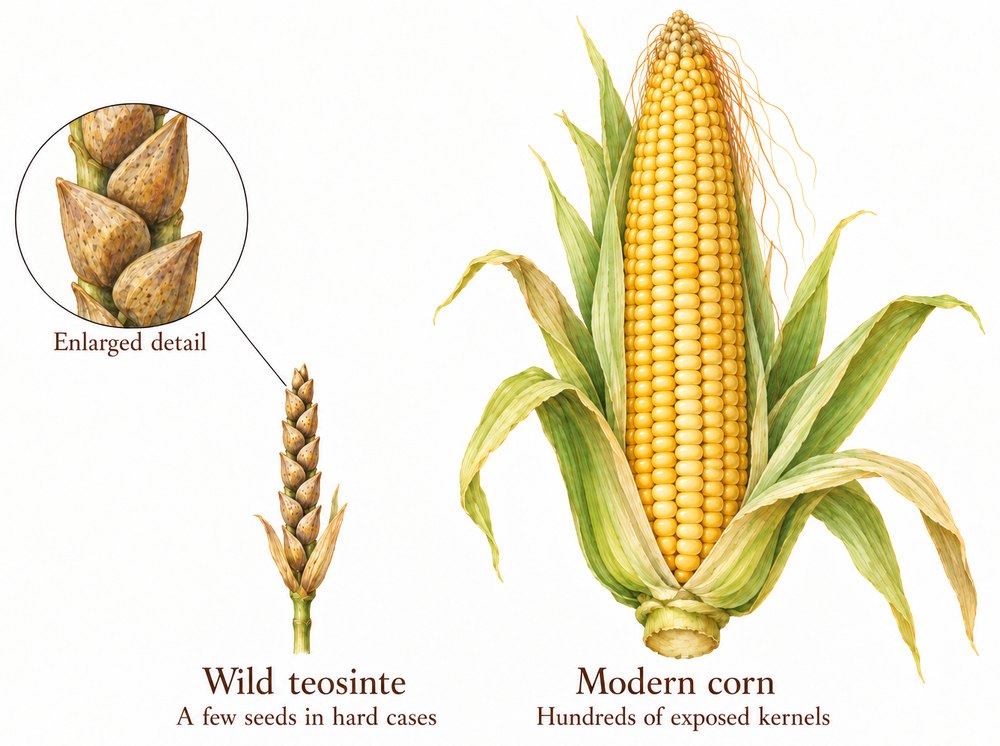
Corn started as a wild grass called teosinte. Its tiny ears had only about a dozen kernels, each one as hard as a pebble. Today one ear of corn has hundreds of soft, sweet kernels.
Bananas in the wild are packed with big, hard seeds. People found a rare banana with almost no seeds and kept growing it. Now we can eat bananas without spitting out seeds.
Seedless grapes came from one special grapevine with no seeds. Farmers grew new vines from its branches, again and again.
One wild plant called wild cabbage turned into six different vegetables: kale, cabbage, broccoli, cauliflower, Brussels sprouts, and kohlrabi. Farmers just picked different parts to make bigger.
This is called artificial selection. “Artificial” means made by people. “Selection” means choosing. People choose which plants and animals get to have babies, and over time the plants and animals change.
What people used to think
For a very long time, most people believed that every kind of animal and plant had always looked exactly the way it looks today. Cats had always been cats. Oak trees had always been oak trees. Nothing ever really changed.
A few curious people wondered. About 200 years ago, a French scientist named Jean-Baptiste Lamarck had an idea: maybe giraffes got long necks by stretching to reach high leaves, and then their babies were born with longer necks. It was a clever guess. But it was wrong. If you stretch every day, your future children will not be born taller!
So the big mystery was still there. Why are there so many different kinds of living things?
A young explorer sets sail
In 1831, a 22-year-old named Charles Darwin got on a ship called the Beagle. He sailed around the world for almost five years. He climbed mountains, rode horses across plains, and filled boxes with bugs, bones, plants, and birds.
In South America, he dug up fossils of giant animals that no longer existed, like a ground sloth as big as an elephant. They looked a lot like the smaller animals still living there. Strange, he thought.
Then the ship reached the Galápagos Islands, far out in the Pacific Ocean. The giant tortoises there had different shell shapes on different islands. And there were lots of little brown birds called finches. They all looked like cousins, but their beaks were different. Each beak fit the food that bird ate.
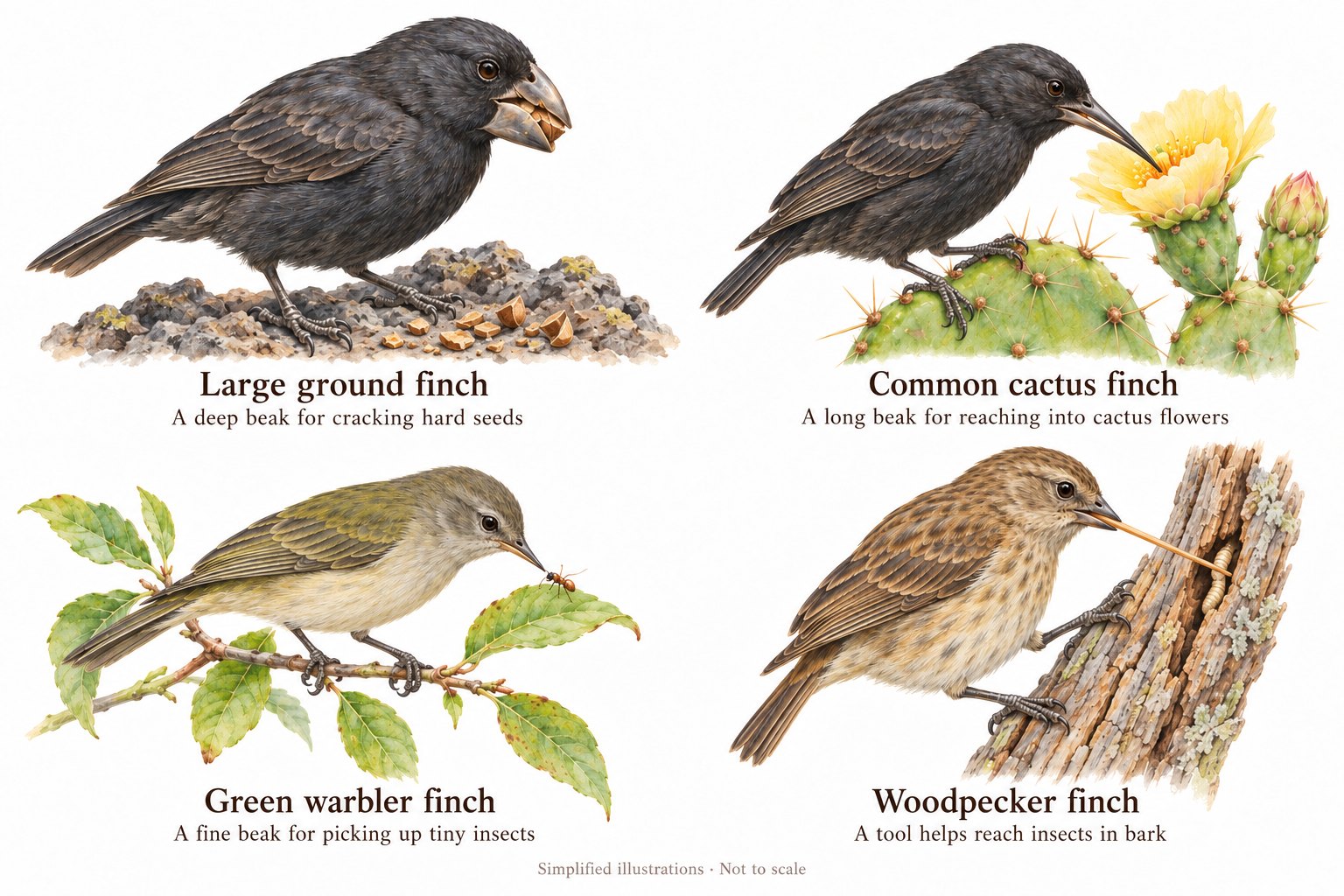 Four of the Galápagos finches. They come from the same ancestor, but each beak became a tool for a different food.
The big idea
Back home in England, Darwin kept thinking about it for years. He talked to farmers and pigeon breeders about how they made new kinds of animals. And then it clicked.
Farmers choose which animals have babies. But what if nature can choose too? In the wild, there is not enough food for everyone. The animals that fit their home best, like a finch with just the right beak, survive and have more babies. Their babies have the same helpful beaks. Over a very long time, one kind of finch can turn into many kinds.
Darwin called this natural selection, because nature does the choosing. He wrote it all down in a famous book in 1859.
It is one of the simplest ideas in all of science. Farmers and dog breeders had been doing it for thousands of years. The secret was hiding in plain sight the whole time. It just took someone to notice that nature does it too.
Three tricky questions
Darwin’s idea leads to some puzzles that even grown-ups get wrong. Can you guess the answers?
- Is a chimpanzee more closely related to a gorilla, or to you?
- Is a mushroom a closer cousin to a tree, or to you?
- Long ago, there were other kinds of humans on Earth. Where did they go?
Find out in Part 2.
Part 2: How Life Changes
In Part 1, Darwin figured out that nature chooses, the same way farmers do. But how does a finch “get” a new beak in the first place? The answer is hiding inside every living thing.
Copies with tiny changes
Every living thing carries a set of instructions inside its cells, a little like a recipe book for building a body. These instructions are written in a molecule called DNA. A piece of DNA that does one job, such as helping to decide your eye color, is called a gene.
You got half of your DNA from your mother and half from your father. That is why you might have one parent’s smile and the other’s nose. But the copy is never perfect. A few tiny changes, called mutations, slip in every time. You were born with about 60 of them that neither of your parents had.
The same thing happens to every living thing, from finches to flowers. When a baby finch hatches, its DNA has a few tiny changes too. Most of them do nothing. A few cause problems. And once in a while, one gives the bird a small advantage, like a slightly stronger beak. Those lucky changes are what nature gets to choose from.
Natural selection in three steps
- Everyone is a little different. In a group of finches, some are born with slightly bigger beaks, some with smaller ones.
- Some differences help. If the only food left is hard seeds, birds with stronger beaks eat better and survive.
- Winners pass it on. Those birds have more chicks, and the chicks inherit the strong beaks. Over many generations, the whole group changes.
Over millions of years, these small changes add up to big ones. Scientists call this slow change of living things over time evolution. When two groups change so much that they can no longer have babies together, they have become different species.
Caught in the act. In 1977, a terrible drought hit one small Galápagos island. The small, soft seeds ran out, and only big, hard seeds were left. Two scientists, Peter and Rosemary Grant, had been measuring every finch on the island. Most of the finches died. The survivors had bigger beaks, and so did their chicks. The Grants watched evolution happen in just a few years.
One giant family tree
Darwin did not know about DNA. Today we can read the DNA of almost any living thing. When scientists compare DNA from different species, they can tell who is a close relative and who is a distant cousin. Putting it all together gives us the tree of life.
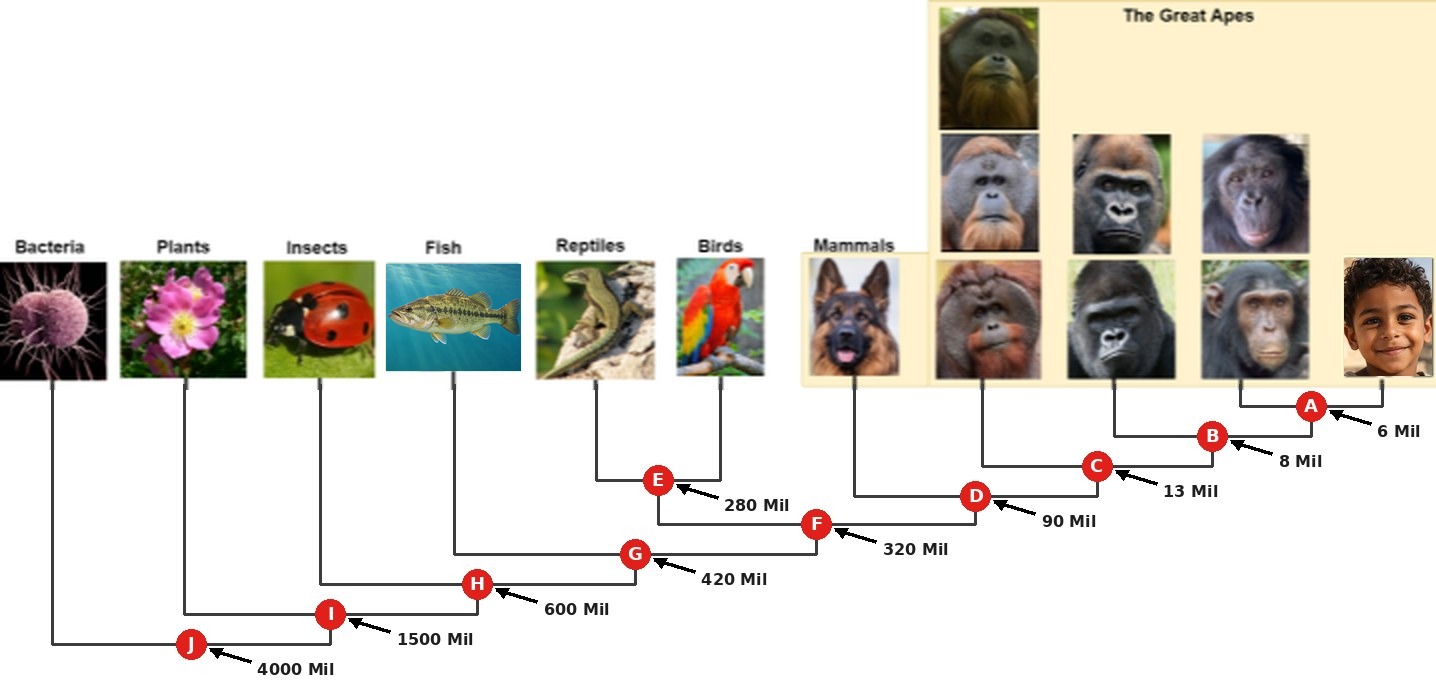 The tree of life. Each red dot is a common ancestor, with roughly how many millions of years ago (“Mil”) it lived. Branch lengths are not to scale, and every living thing at the top has been evolving for exactly the same amount of time.
Start at the child on the right and follow the red dots back to the left. Dot A is the ancestor we share with chimpanzees, who lived about 6 million years ago. That is roughly 250,000 generations of grandparents ago. Keep going, and you meet the ancestor we share with dogs (D), then with birds and reptiles (F), then with fish (G). Notice dot E: birds branch off together with the reptiles, because birds are a kind of reptile. Go back far enough and you reach a simple cell that lived about 4 billion years ago, the great-great-great-grandparent of everything alive.
The tricky questions, answered
Is a chimpanzee more closely related to a gorilla, or to you?
To you! Chimpanzees and gorillas look alike, with their dark fur and long arms. But look at the tree. The chimp and the human meet first, at dot A, about 6 million years ago. The gorilla joins the family later, at dot B, about 8 million years ago. So a chimpanzee is a closer cousin to you than to a gorilla. Fascinating, right?
Does that mean we came from chimpanzees? No. Chimps and humans are cousins, not parents and children. Think about your own family. You and your cousin share the same grandparents, but you did not come from your cousin. You are both here at the same time, on different branches.
Chimps and humans share a great-great-great (keep going for a very long time) grandmother who lived about 6 million years ago. She did not look like a chimpanzee, and she did not look like you. Some of her children’s children slowly became today’s chimps. Others slowly became us.
Is a mushroom a closer cousin to a tree, or to you?
To you! Mushrooms are not plants. They belong to a group called fungi. DNA shows that the ancestor we share with mushrooms lived a little over a billion years ago, while the ancestor we share with trees lived even earlier, about 1.5 billion years ago. So the mushroom joined our side of the family after the trees had already gone their own way.
You can see the clues in how a mushroom lives:
It eats like you. A tree makes its own food from sunlight. A mushroom can’t. It has to take in food from around it, just like you do.
It saves energy like you. Plants store extra energy as starch. Mushrooms store it as glycogen, the same thing your muscles and liver use.
Its walls are made like a bug’s shell. Plant cells are wrapped in wood-like cellulose. Mushroom cells are wrapped in chitin, the same tough stuff in a beetle’s shell.
And here is the most surprising part: the mushroom you see is only the fruit. The real fungus is a web of thin threads hiding underground. One fungus in a forest in Oregon has spread underground over an area bigger than a thousand soccer fields. It may be the largest living thing on Earth.
Long ago, there were other kinds of humans on Earth. Where did they go?
For most of human history, Earth had several kinds of humans at the same time. Our own kind, Homo sapiens, slowly evolved in Africa. The oldest bones of people like us are about 300,000 years old. When some of our ancestors left Africa, roughly 60,000 years ago, they met other humans who were already there:
Neanderthals lived in Europe and western Asia. They were strong, made tools, and built fires.
Denisovans lived across Asia. We know them from just a few bones and teeth, and from their DNA.
The “hobbits” of Flores, an island in Indonesia, were only about one meter (three feet) tall.
All of them are gone now. The last Neanderthals disappeared about 40,000 years ago, and scientists are still working out exactly why. But they did not vanish completely. Our ancestors sometimes had children with them, so most people whose families come from outside Africa carry a little Neanderthal DNA. Our lost cousins are still with us, inside our cells.
More questions to blow your mind
Are humans still changing today?
Yes. Evolution never stops. A few examples from the last few thousand years:
Drinking milk. Most mammals can only digest milk when they are babies. But where people kept cows, goats, and camels, a change that lets grown-ups drink milk spread fast.
Breathing thin air. High in the mountains of Tibet, the air has much less oxygen. Many Tibetans carry a gene that helps them breathe easily up there.
Diving deep. The Bajau people of Southeast Asia have dived for food for over a thousand years. Many have bigger spleens, which helps them stay underwater longer.
Evolution is slow, so you will not see it happen in your lifetime. But it is happening right now, to every living thing, including you.
Is evolution heading somewhere?
No. Evolution has no goal and no finish line. It does not try to make living things bigger or smarter. It only keeps what works in a certain place, at a certain time. And traits can disappear as easily as they appear:
Whales lost their back legs. Some still have tiny hip bones hidden inside.
Some fish living in dark caves lost their eyes. In total darkness, eyes are useless.
Ostriches and kiwis came from birds that could fly. They became runners instead.
Snakes came from lizards with legs.
Humans are not the “top” of evolution either. We are one twig on a giant tree. A bacterium that has survived for billions of years is a winner too.
Why do some people who live far from Africa have dark skin?
People in Papua New Guinea, the Solomon Islands, and parts of Australia and southern Asia often have dark skin and curly hair. Many people guess they must be close relatives of people in Africa. But their DNA says something different. Their ancestors left Africa with the same group that later spread into Asia and Europe. So in their DNA, they are closer to people in East Asia than to people in Africa.
Why the dark skin, then? It protects the body from strong sunshine near the equator. In sunny places, dark skin keeps working, so it stays common. Groups who moved far north, where the sun is weak, slowly evolved lighter skin, which helps the body make vitamin D. Lighter skin even evolved more than once, in different ways in Europe and in East Asia.
The lesson: skin color mostly tells us about sunshine, not about family. In fact, Africa has more human variety in its DNA than the rest of the world put together. Underneath our skin, all humans are one close family.
Why it matters
Evolution tells us that every living thing is family. The bacteria in the soil, the tree outside your window, the mushroom in the forest, and your dog are all distant relatives. It also shows how special we are. Many kinds of humans once walked the Earth, and only one is left.
Today, people are changing the planet very quickly, by heating the climate, cutting forests, and spreading pollution. Many species cannot evolve fast enough to keep up. Understanding evolution helps us see why protecting nature matters so much.
You are a leaf on a tree that is 4 billion years old. Look after the rest of the tree.
Words to know
Artificial selection: When people choose which plants or animals get to have babies.
Natural selection: When living things that fit their home best survive and have more babies.
DNA: The instructions inside every living cell, passed from parents to children.
Mutation: A tiny change in DNA that happens when it is copied.
Species: A group of living things that can have babies together.
Try this
At the grocery store, find kale, cabbage, broccoli, and Brussels sprouts. They all came from the same wild plant! Farmers made a different part bigger in each one. Can you match them?
Leaves · Top bud · Flowers · Side buds
Answers: kale = leaves, cabbage = top bud, broccoli = flowers, Brussels sprouts = side buds.