The Matryoshka Universe
A journey from galaxies down to atoms
Published:
Part 1: Dolls Inside Dolls
Imagine someone hands you a round, painted wooden doll. It is smiling, with rosy cheeks and a bright red scarf. You give it a shake. Something rattles inside!
You twist the doll open. Inside is another doll, just like the first, only smaller. You shake that one. Another rattle. Inside is an even smaller doll, and inside that one, another…
This doll is called a matryoshka, and it comes from Russia. And here is a secret: the whole universe is built just like it. It is made of things inside things inside things. Let’s open the dolls one at a time, starting with the biggest.
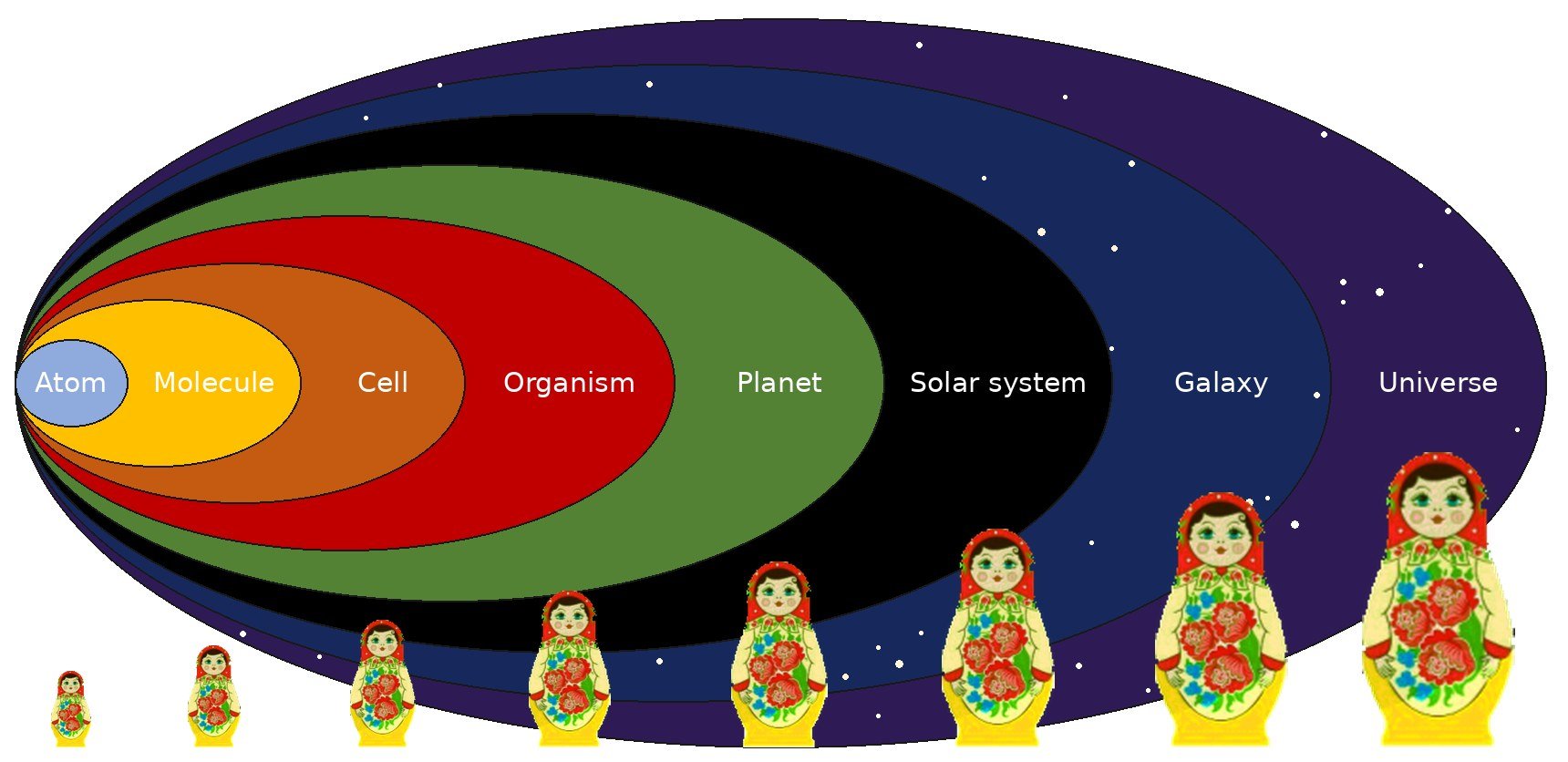 The Matryoshka Universe: each world fits inside a bigger one, like nesting dolls.
The biggest doll: the universe
The universe is everything there is: all of space, and everything in it. It is so big that even light, the fastest thing there is, could not cross the part we can see in billions and billions of years. Inside the universe are hundreds of billions of galaxies.
Open it: a galaxy
A galaxy is a giant swirl of stars. Ours is called the Milky Way. It has more than 100 billion stars. On a very dark night, far from city lights, you can see part of it stretching across the sky like a stripe of spilled milk.
Open it: our solar system
One of those stars is our Sun. The Sun is so big that about a million Earths could fit inside it. Around it travel eight planets, plus moons, comets, and space rocks. Together, they are our solar system. Sunlight takes about eight minutes to reach us. The sunshine warming your face right now left the Sun eight minutes ago.
Open it: a planet
The third planet from the Sun is our home, Earth. It is a giant ball of rock, mostly covered with water. It is so big that if you walked all the way around it without ever stopping, the trip would take you almost a whole year. And Earth is never still: it spins once every day, giving us day and night, and it races around the Sun so fast that right now you are zooming through space at about 30 kilometers every second, faster than a rocket leaving Earth. It is the only planet we know of with oceans, air we can breathe, and life.
Open it: an organism
An organism is any living thing. Earth is covered with them: trees, whales, ants, mushrooms, and you. Scientists have named about two million kinds, and millions more are still waiting to be discovered. Some are giants, like the blue whale, the biggest animal that has ever lived, as far as we know. Others are so tiny you need a microscope to see them. A single handful of soil holds more living things than there are people on Earth!
Open it: a cell
Every living thing is built from cells. They are so small that hundreds of them could sit on the period at the end of this sentence. Some living things, like bacteria, are just one cell. You are made of about 30 trillion. That is more than the number of stars in our whole galaxy! And your cells are not all the same. Skin cells, muscle cells, and brain cells each have their own job, and some, like your blood cells, travel all around your body.
Open it: a molecule
Inside every cell are molecules. A molecule is a tiny group of atoms stuck together. Water is a molecule. One glass of water has more water molecules in it than there are stars in all the galaxies we can see! The sugar in your cookie is made of molecules too. One of the most amazing molecules is DNA, a long, twisty instruction book that tells your cells how to build you.
Open it: an atom
Molecules are made of atoms. Atoms are so small that a single hair on your head is hundreds of thousands of atoms wide. Everything you can touch, from your toothbrush to the Moon, is made of atoms.
Three big questions
Opening the dolls leaves us with some giant puzzles. Can you guess the answers?
- Is there an even smaller doll hiding inside the atom?
- How were all the dolls made?
- How can we see things that are too small or too far for our eyes?
Find out in Part 2.
Part 2: How the Dolls Were Made
In Part 1, we opened the dolls from the universe all the way down to the atom. Now let’s answer the big questions.
Is there an even smaller doll hiding inside the atom?
Yes! For a long time, people thought atoms were the smallest things there are. They were wrong. An atom has a tiny center called the nucleus, made of protons and neutrons. Even tinier electrons zip around it.
And here is a surprise: an atom is almost completely empty. If an atom were as big as a football stadium, its nucleus would be about the size of a pea in the middle.
Open the dolls one more time, and protons and neutrons turn out to be made of even smaller pieces called quarks. Are there more dolls inside the quarks? Nobody knows yet. Scientists are still working to find out, because our machines are not yet powerful enough to look that closely.
How were all the dolls made?
Scientists have pieced together the story from clues in space and on Earth:
- 13.8 billion years ago: a hot, tiny beginning. Long ago, everything in the universe was packed close together and very hot. Since then, the universe has been growing and cooling, and it is still growing today.
- The first stars. As the universe cooled, clouds of gas pulled together and lit up as stars. Inside them, small atoms were squeezed into bigger ones, like carbon and oxygen. When big stars exploded, they scattered those atoms into space. That is the star dust you are made of.
- About 4.6 billion years ago: the Sun and Earth. A cloud of gas and star dust collapsed into our Sun, and leftover pieces clumped into planets, including Earth.
- By 3.5 billion years ago: the first life. Tiny living cells were already living in Earth’s oceans. Exactly how the first cell formed is still one of science’s biggest mysteries.
- About 600 million years ago: the first animals. The first animals appeared in the sea. Much later came fish, dinosaurs, flowers, and finally people.
So the biggest doll made the smaller ones. The universe made stars, the stars made atoms, the atoms built planets and cells, and the cells built you.
How can we see things that are too small or too far for our eyes?
With amazing tools. A simple microscope can show you cells in a drop of pond water. Scientists use electron microscopes so powerful they can show single atoms. To study the tiny pieces inside atoms, they use machines like the Large Hadron Collider, a ring 27 kilometers (17 miles) around that smashes particles together.
Looking outward, a small backyard telescope can show you the rings of Saturn and the moons of Jupiter. Giant space telescopes, like the James Webb Space Telescope, can see galaxies so far away that their light left them more than 13 billion years ago. Looking far away is like looking back in time.
The doll that knows
Here is something amazing. An atom does not know it is part of a molecule. A cell does not know it is part of you. But you can learn about all the dolls: the tiny ones inside you and the giant ones all around you. As far as we know, people are the only dolls that can do that.
In 1968, three astronauts flew all the way around the Moon. As their spaceship came around, they saw something no one had ever seen: the Earth rising over the Moon, a small blue-and-white ball floating in the dark. One of them, Bill Anders, took a photo of it, now called Earthrise. For the first time, people looked at the doll they live in from the outside.
Mysteries waiting for you
Even with all these tools, the universe still has secrets:
Invisible stuff. Most of the universe seems to be made of something we cannot see, called dark matter and dark energy. Nobody knows what they are.
The very beginning. What was the universe like at its very first moment?
The first cell. How did lifeless molecules become something alive?
Other life. Is anyone else out there, on a planet around another star?
The dolls are still waiting to be opened. Maybe you will be the one to open the next one.
Words to know
Galaxy: A giant group of stars. Ours is the Milky Way.
Solar system: The Sun and everything that travels around it.
Organism: Any living thing, like a tree, an ant, or you.
Cell: The tiny building block of every living thing.
Molecule: A small group of atoms stuck together.
Atom: The tiny piece that everything you can touch is made of.
Try this
Put the dolls in order! Starting with the biggest, sort these: atom, galaxy, cell, planet, universe, molecule, solar system, you.
Answer: universe, galaxy, solar system, planet, you, cell, molecule, atom.